Field of view: Difference between revisions
CSV import Tags: mobile edit mobile web edit |
CSV import |
||
| Line 39: | Line 39: | ||
{{Medicine-stub}} | {{Medicine-stub}} | ||
<gallery> | |||
File:FOV_both_eyes.svg|Field of view of both eyes | |||
File:Vertical_FOV.svg|Vertical field of view | |||
File:Angle_of_view.svg|Angle of view | |||
File:Abdominal_CT_with_scan_range_and_field_of_view,_with_box_and_text.jpg|Abdominal CT with scan range and field of view | |||
File:Field_of_view_diameter_in_microscopy.jpg|Field of view diameter in microscopy | |||
</gallery> | |||
Latest revision as of 05:04, 18 February 2025
Field of View (FOV) refers to the extent of the observable world that can be seen at any given moment. In the context of vision, it is often described as the angle through which a person can see objects surrounding their point of focus. The concept of FOV is not limited to human vision; it is also applicable in photography, optics, and computing, particularly in areas such as virtual reality (VR), video games, and imaging technologies.
Definition[edit]
The field of view is typically expressed as an angle, indicating the angular extent of the observable area. In humans, the combined FOV of both eyes covers about 200 to 220 degrees horizontally, though much of this field is peripheral vision. The central part of the field of view, where we can see details most clearly, is much narrower.
Applications[edit]
Photography[edit]
In Photography, the FOV is determined by the focal length of the lens and the size of the image sensor or film. A wider FOV allows more of the scene to be captured, which is often desirable in landscape photography.
Optics[edit]
In Optics, instruments such as binoculars and telescopes have a specified FOV, which describes the diameter of the visible area observed through the instrument. A wider FOV in these contexts allows for a larger portion of the sky or landscape to be observed at once.
Virtual Reality[edit]
In Virtual Reality (VR), FOV is crucial for creating an immersive experience. A wider FOV in VR can make virtual environments feel more real and expansive, but achieving this often requires more advanced and expensive technology.
Video Games[edit]
In Video Games, the FOV affects how much of the game world the player can see on their screen. A wider FOV can provide a competitive advantage in multiplayer games by allowing players to see more of their surroundings.
Measurement[edit]
FOV can be measured in degrees, radians, or as a linear measurement at a certain distance. When measuring the FOV of cameras or lenses, two main types are often discussed: horizontal FOV and vertical FOV. The diagonal FOV can also be relevant, especially in the context of imaging sensors.
Human Vision[edit]
The human FOV varies significantly among individuals but generally encompasses a wide area that includes both central and peripheral vision. The central FOV, where we have the sharpest vision, is only about 15 degrees on either side of the focal point.
Limitations and Enhancements[edit]
Certain conditions and technologies can limit or expand the FOV. For example, wearing glasses or goggles can restrict the FOV by blocking parts of the peripheral vision. Conversely, technologies like wide-angle lenses or panoramic photography can significantly expand the FOV beyond what is naturally possible.
See Also[edit]

-
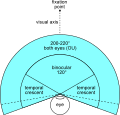 Field of view of both eyes
 -
 Vertical field of view
 -
 Angle of view
 -
 Abdominal CT with scan range and field of view
 -
 Field of view diameter in microscopy


