Nasi kerabu: Difference between revisions
CSV import Tags: mobile edit mobile web edit |
CSV import |
||
| Line 20: | Line 20: | ||
{{Malaysia-food-stub}} | {{Malaysia-food-stub}} | ||
{{food-stub}} | {{food-stub}} | ||
<gallery> | |||
File:Nasi_kerabu.jpg|Nasi kerabu | |||
File:Souththailandmap.GIF|Map of South Thailand | |||
File:Bunga_telang_(potret_dari_dekat).jpg|Bunga telang (close-up portrait) | |||
File:Nasi_kerabu_2.jpg|Nasi kerabu | |||
File:YosriNasiKerabu1.jpg|Nasi kerabu | |||
</gallery> | |||
Latest revision as of 05:04, 18 February 2025
Nasi Kerabu is a traditional Malay dish that originates from the Kelantan region of Malaysia. It is a type of rice dish that is often characterized by its blue color, which is derived from the petals of the butterfly-pea flower.
Overview[edit]
Nasi Kerabu is a flavorful and aromatic dish that is often enjoyed for breakfast, although it can be eaten at any time of the day. The dish is made by combining cooked rice with a variety of herbs, spices, and other ingredients. The blue color of the rice is achieved by steeping the butterfly-pea flower petals in water and then using this water to cook the rice.
Ingredients[edit]
The main ingredients of Nasi Kerabu are rice, butterfly-pea flower petals, and a variety of herbs and spices. These may include lemongrass, kaffir lime leaves, ginger, garlic, and chili peppers. The dish is often served with a side of grilled fish, fried chicken, or other types of meat. It may also be accompanied by a variety of sambal, a spicy condiment made from chili peppers, and a variety of fresh vegetables.
Cultural Significance[edit]
Nasi Kerabu is a significant part of Malay culture and is often served during special occasions and festivals. It is also a popular street food in Malaysia and can be found in many local markets and food stalls.
See Also[edit]
This Malaysia-food related article is a stub. You can help WikiMD by expanding it.

-
 Nasi kerabu
 -
 Map of South Thailand
 -
 Bunga telang (close-up portrait)
 -
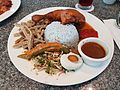 Nasi kerabu
 -
 Nasi kerabu


.jpg)


