Disease vector: Difference between revisions
CSV import |
CSV import |
||
| Line 27: | Line 27: | ||
{{medicine-stub}} | {{medicine-stub}} | ||
<gallery> | |||
File:Anopheles_stephensi.jpeg|Anopheles stephensi mosquito | |||
File:Adult_deer_tick(cropped).jpg|Adult deer tick | |||
File:Disease_Vector.jpg|Disease vector | |||
File:Gilded_Vectors_of_Disease_-_Horizontal.jpg|Gilded vectors of disease | |||
</gallery> | |||
Latest revision as of 05:04, 18 February 2025
Disease vector refers to any living organism that can carry and transmit an infectious pathogen into another living organism. Vectors are typically bloodsucking insects and ticks which play a crucial role in the transmission of diseases between humans or from animals to humans. Many of the world's major diseases, including Zika virus, Malaria, Dengue fever, and Lyme disease, are transmitted by these vectors. Understanding the biology and ecology of vectors is essential for the development of strategies to prevent disease transmission.
Types of Vectors[edit]
Vectors can be categorized into two main types: biological vectors and mechanical vectors.
Biological Vectors[edit]
Biological vectors, such as mosquitoes, ticks, and fleas, have a complex life cycle that allows the pathogen to multiply or develop within the organism before the pathogen is transmitted to a new host. For example, the Anopheles mosquito is a well-known vector for malaria, as it allows the malaria parasite to complete its lifecycle within the mosquito before it is passed on to humans.
Mechanical Vectors[edit]
Mechanical vectors, on the other hand, transmit pathogens from one host to another without the pathogen needing to complete its life cycle within the vector. Common examples include flies and cockroaches, which can carry pathogens on their bodies from feces or decaying matter to food or wounds.
Vector-borne Diseases[edit]
Vector-borne diseases are infections transmitted by the bite of infected arthropod species, such as mosquitoes, ticks, triatomine bugs, sandflies, and blackflies. According to the World Health Organization (WHO), vector-borne diseases account for more than 17% of all infectious diseases, causing more than 700,000 deaths annually.
Prevention and Control[edit]
Preventing vector-borne diseases involves protecting individuals from vector bites and reducing vector populations. Strategies include the use of insect repellent, wearing long-sleeved shirts and long pants, using bed nets, and eliminating standing water where mosquitoes breed. Community-wide efforts may also include insecticide spraying and the release of genetically modified or sterile male mosquitoes to reduce mosquito populations.
Research and Development[edit]
Ongoing research aims to better understand vector biology, ecology, and control. This includes the development of new tools and strategies for vector control, vaccines to prevent vector-borne diseases, and improved diagnostics. The Genetic modification of disease vectors is a promising area of research that could lead to significant reductions in vector populations or the ability of vectors to transmit pathogens.
Conclusion[edit]
Disease vectors play a significant role in the transmission of infectious diseases. Effective control and prevention of vector-borne diseases require a comprehensive understanding of vector biology, ecology, and the development of innovative control strategies. Public health efforts must continue to focus on reducing the risk of disease transmission through vector control, surveillance, and education.
 | This medical article is a stub. You can help Wikipedia by adding missing information. |
-
 Anopheles stephensi mosquito
 -
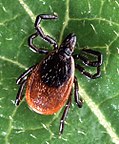 Adult deer tick
 -
 Disease vector
 -
 Gilded vectors of disease

.jpg)


