IUCN Red List: Difference between revisions
CSV import Tags: mobile edit mobile web edit |
CSV import |
||
| Line 37: | Line 37: | ||
[[Category:Biodiversity]] | [[Category:Biodiversity]] | ||
{{conservation-stub}} | {{conservation-stub}} | ||
<gallery> | |||
File:IUCN_Red_List.svg|IUCN Red List logo | |||
File:IUCN_Red_List_-_December_2023.svg|IUCN Red List - December 2023 update | |||
File:Sizes_of_Red_List_Categories.png|Sizes of Red List Categories | |||
File:Status_iucn2.3.svg|IUCN Red List status version 2.3 | |||
</gallery> | |||
Latest revision as of 05:04, 18 February 2025
IUCN Red List
The International Union for Conservation of Nature (IUCN) Red List is a comprehensive inventory of the global conservation status of biological species. It uses a set of criteria to evaluate the extinction risk of thousands of species and subspecies. These criteria are relevant to all species and all regions of the world.
History[edit]
The IUCN Red List was established in 1964 by the World Conservation Union (IUCN). The aim was to highlight those species that were facing a higher risk of global extinction (i.e., those listed as Critically Endangered, Endangered and Vulnerable).
Criteria[edit]
The IUCN Red List categorizes species into nine different conservation statuses: Not Evaluated, Data Deficient, Least Concern, Near Threatened, Vulnerable, Endangered, Critically Endangered, Extinct in the Wild, and Extinct. The criteria for these categories are based on a species' rate of decline, population size, area of geographic distribution, and degree of population and distribution fragmentation.
Impact[edit]
The IUCN Red List has been instrumental in guiding conservation activities of governments, NGOs and scientific institutions. The data and analyses provide an important foundation for biodiversity conservation, informing about key threats and actions needed to prevent species extinctions.
Criticism[edit]
Despite its broad usage, the IUCN Red List has been criticized for its emphasis on vertebrates and lack of coverage of invertebrates and fungi. Additionally, some critics argue that the criteria for listing are too stringent, potentially excluding species that are in need of conservation attention.
See also[edit]
References[edit]
<references group="" responsive="1"></references>
External links[edit]

-
IUCN Red List logo
-
 IUCN Red List - December 2023 update
 -
 Sizes of Red List Categories
 -
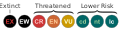 IUCN Red List status version 2.3


