Weibull distribution: Difference between revisions
CSV import |
CSV import |
||
| Line 39: | Line 39: | ||
{{Probability-stub}} | {{Probability-stub}} | ||
<gallery> | |||
File:Weibull_PDF.svg|Probability Density Function of Weibull Distribution | |||
File:Weibull_CDF.svg|Cumulative Distribution Function of Weibull Distribution | |||
File:Weibull_qq.svg|Q-Q Plot for Weibull Distribution | |||
File:FitWeibullDistr.tif|Fitting Weibull Distribution | |||
File:DCA_with_four_RDC.png|DCA with Four RDC | |||
</gallery> | |||
Latest revision as of 05:01, 18 February 2025
Weibull distribution is a continuous probability distribution. Named after Waloddi Weibull, who described it in detail in 1951, though it was first identified by Fréchet in 1927 and first applied by Rosin & Rammler in 1933 to describe a particle size distribution. The Weibull distribution is a versatile distribution that can express a wide range of shapes depending on its parameters. It is commonly used in reliability engineering, failure analysis, forecasting, and weather forecasting.
Definition[edit]
The probability density function (pdf) of the Weibull distribution for a random variable X is given by:
- f(x; \lambda, k) = \frac{k}{\lambda} \left( \frac{x}{\lambda} \right)^{k-1} e^{-(x/\lambda)^k} for x \geq 0,
where k > 0 is the shape parameter and \lambda > 0 is the scale parameter of the distribution. The case where x = 0 and k < 1 needs to be handled separately, as the density tends to infinity.
Characteristics[edit]
The Weibull distribution is characterized by its shape parameter k. When k < 1, the distribution models data with a high failure rate as the item ages. When k = 1, the Weibull distribution simplifies to an exponential distribution. When k > 1, it models data with a decreasing failure rate, which is common in reliability engineering where it is assumed that an item's failure rate decreases as defective items are eliminated.
The scale parameter \lambda affects the spread of the distribution without altering its shape. A larger \lambda value indicates a wider spread.
Applications[edit]
The Weibull distribution is widely used in various fields due to its flexibility:
- In reliability engineering and survival analysis, it helps in modeling the life of products and organisms.
- In weather forecasting, it models wind speed distributions.
- In economics, it can model income distributions under certain conditions.
- In hydrology, it is used to model extreme events such as annual maximum one-day rainfalls.
Parameter Estimation[edit]
Parameters of the Weibull distribution can be estimated using methods such as the Maximum Likelihood Estimation (MLE) or the method of moments. The MLE approach is more commonly used due to its statistical properties.
Related Distributions[edit]
- If X is a random variable with a Weibull distribution, then ln(X) follows an extreme value distribution.
- The Weibull distribution is a special case of the Generalized Extreme Value Distribution (GEVD) when the shape parameter is positive.
See Also[edit]
- Exponential distribution
- Reliability engineering
- Survival analysis
- Maximum Likelihood Estimation (MLE)

This article is a probability-related stub. You can help WikiMD by expanding it!
-
 Probability Density Function of Weibull Distribution
 -
 Cumulative Distribution Function of Weibull Distribution
 -
 Q-Q Plot for Weibull Distribution
 -
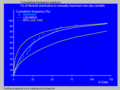 Fitting Weibull Distribution
 -
 DCA with Four RDC


