Cirsium arvense: Difference between revisions
CSV import |
CSV import Tags: mobile edit mobile web edit |
||
| Line 26: | Line 26: | ||
[[Category:Invasive plant species in the United States]] | [[Category:Invasive plant species in the United States]] | ||
[[Category:Cirsium]] | [[Category:Cirsium]] | ||
<gallery> | |||
File:Cirsium_arvense_-_põldohakas.jpg|Cirsium arvense | |||
File:Maniola_jurtina_2_RF.jpg|Maniola jurtina | |||
File:Carduelis_carduelis2.jpg|Carduelis carduelis | |||
File:Rust_Mite,_Aceria_anthocoptes.jpg|Aceria anthocoptes | |||
</gallery> | |||
Latest revision as of 05:00, 18 February 2025
Cirsium arvense, commonly known as Creeping Thistle, is a species of Cirsium, belonging to the family Asteraceae. This perennial plant is native to Europe and Asia, but has also become widespread in North America.
Description[edit]
Cirsium arvense is a herbaceous perennial plant that grows up to 150 cm tall. The stems are erect, branched and have spiny wings. The leaves are oblong, with lobes that have sharp spines at the tips. The flowers are pink to purple and are produced in dense clusters.
Distribution and habitat[edit]
Cirsium arvense is native to Europe and Asia, but has been introduced to North America, where it has become an invasive species. It is found in a wide range of habitats, including grasslands, open woodlands, and disturbed areas.
Ecology[edit]
Cirsium arvense is a food plant for the larvae of several species of Lepidoptera, including the Painted Lady butterfly. It is also visited by a wide range of pollinators, including bees and butterflies.
Uses[edit]
Cirsium arvense has been used in traditional medicine for its anti-inflammatory and diuretic properties. It is also used as a food plant by some cultures.
Control[edit]
Control of Cirsium arvense is challenging due to its extensive root system and ability to regenerate from root fragments. Methods of control include mowing, herbicide application, and biological control using insects or fungi.
See also[edit]

-
 Cirsium arvense
 -
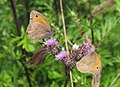 Maniola jurtina
 -
 Carduelis carduelis
 -
 Aceria anthocoptes


