Thumb hypoplasia: Difference between revisions
CSV import Tags: mobile edit mobile web edit |
CSV import Tags: mobile edit mobile web edit |
||
| Line 29: | Line 29: | ||
[[Category:Hand disorders]] | [[Category:Hand disorders]] | ||
{{Medicine-stub}} | {{Medicine-stub}} | ||
<gallery> | |||
File:Thumb_hypoplasia_type_2.png|Thumb hypoplasia type 2 | |||
File:Thumb_hypoplasia_type_3a.png|Thumb hypoplasia type 3a | |||
File:Thumb_hypoplasia_type_3b.jpg|Thumb hypoplasia type 3b | |||
File:Thumb_hypoplasia_type_4.jpg|Thumb hypoplasia type 4 | |||
File:Thumb_hypoplasia_type_5.png|Thumb hypoplasia type 5 | |||
</gallery> | |||
Latest revision as of 05:00, 18 February 2025
Thumb Hypoplasia is a medical condition characterized by the underdevelopment or absence of the thumb. This condition is often congenital, meaning it is present at birth. Thumb hypoplasia can occur as an isolated anomaly, or it can be associated with a broader syndrome, such as Holt-Oram syndrome or Fanconi anemia.
Etiology[edit]
The exact cause of thumb hypoplasia is not known. However, it is believed to be due to a disruption in the normal development of the thumb during the embryonic stage of pregnancy. Some studies suggest that genetic factors may play a role, particularly in cases where thumb hypoplasia is part of a broader syndrome.
Classification[edit]
Thumb hypoplasia is classified into five types, ranging from Type I, which involves minor underdevelopment, to Type V, which is characterized by the complete absence of the thumb, a condition known as thumb aplasia.
Diagnosis[edit]
Diagnosis of thumb hypoplasia is typically made through a physical examination of the hand. In some cases, imaging tests such as X-ray or MRI may be used to assess the extent of the underdevelopment and to plan for surgical intervention if necessary.
Treatment[edit]
Treatment for thumb hypoplasia depends on the severity of the condition. In mild cases, no treatment may be necessary. In more severe cases, surgical intervention may be required to improve function and appearance. This can involve procedures such as pollicization, which involves creating a new thumb from another digit, or thumb reconstruction, which involves using grafts and implants to build a functional thumb.
Prognosis[edit]
The prognosis for individuals with thumb hypoplasia varies depending on the severity of the condition and the success of any surgical interventions. With appropriate treatment, many individuals with thumb hypoplasia can achieve good hand function and a normal appearance.
See Also[edit]

-
 Thumb hypoplasia type 2
 -
 Thumb hypoplasia type 3a
 -
 Thumb hypoplasia type 3b
 -
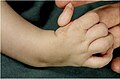 Thumb hypoplasia type 4
 -
 Thumb hypoplasia type 5


