Braid: Difference between revisions
No edit summary |
CSV import |
||
| Line 39: | Line 39: | ||
[[Category:Crafts]] | [[Category:Crafts]] | ||
{{Stb}} | {{Stb}} | ||
<gallery> | |||
File:Braid_final_rot.jpg|Braid | |||
File:Braid_StepBystep.jpg|Braid Step by Step | |||
File:Braided_Stream_FairbanksTananaRiver.jpg|Braided Stream in Fairbanks Tanana River | |||
File:RG-59.jpg|RG-59 Coaxial Cable | |||
File:Gold_braid_with_star.JPG|Gold Braid with Star | |||
File:Braided_cable_close_up.jpg|Braided Cable Close Up | |||
</gallery> | |||
Latest revision as of 04:59, 18 February 2025
A braid is a complex structure or pattern formed by intertwining three or more strands of flexible material such as textile fibers, wire, or hair. As a noun, the term refers to a narrow strip of fabric used to decorate clothes or curtains, as well as a hairstyle created by braiding or twisting hair. As a verb, it describes the act of forming a braid through the process of weaving or interlacing materials. Braids are not only practical for securing hair and materials but are also used ornamentally to embellish clothing and home décor.
History and Cultural Significance[edit]
Braiding has a rich history that dates back thousands of years in various cultures around the world. It has been used as a means of self-expression, a symbol of status, and a method for creating useful and decorative objects. In ancient civilizations, such as Egypt, braids were used both in hair and in the making of textiles. In many cultures, different braid patterns signify marital status, age, wealth, and social position.
Types of Braids[edit]
Braids can vary widely in complexity and style. Some common types include:
- Three-strand braid: The simplest form of braid, created by interlacing three strands of material.
- French braid: A braid that begins at the crown of the head and incorporates strands of hair from the sides as it moves down.
- Dutch braid: Similar to the French braid, but strands are crossed under instead of over, giving it a 3D effect.
- Fishtail braid: Created by dividing the hair into two sections and alternately pulling small pieces from each side.
- Cornrows: Tight, close to the scalp braids that are often formed in simple, straight lines or intricate designs.
Braiding Techniques[edit]
Braiding involves various techniques and patterns, ranging from simple three-strand braids to complex designs incorporating multiple strands. The process of braiding can be therapeutic and offers a creative outlet for expression. Advanced braiding techniques include:
- Lace braids: Braids that are created by adding new strands of hair only from one side.
- Waterfall braids: Where part of the braided hair is left loose to create a waterfall effect.
- Crown braids: Where the braid wraps around the head to create a crown or halo effect.
Braids in Fashion and Home Decor[edit]
In fashion, braids are used as trimmings and embellishments on garments and accessories. They add texture and visual interest to clothes, bags, and shoes. In home décor, braided materials are used in items like rugs, baskets, and throw pillows, offering a blend of aesthetics and functionality.
Caring for Braids[edit]
Maintaining braids, especially in hair, requires proper care to ensure they remain clean and do not cause damage to the hair or scalp. This includes regular washing with suitable products, moisturizing, and protecting the hair at night with silk or satin headscarves.
See Also[edit]
| This article is a stub. You can help WikiMD by registering to expand it. |
-
Braid
-
Braid Step by Step
-
 Braided Stream in Fairbanks Tanana River
 -
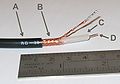 RG-59 Coaxial Cable
 -
 Gold Braid with Star
 -
Braided Cable Close Up


