Flocculus: Difference between revisions
CSV import |
CSV import |
||
| Line 32: | Line 32: | ||
[[Category:Medical terms]] | [[Category:Medical terms]] | ||
{{dictionary-stub1}} | {{dictionary-stub1}} | ||
== Flocculus == | |||
<gallery> | |||
File:Human_brain_midsagittal_view_description.JPG|Midsagittal view of the human brain | |||
File:Human_cerebellum_anterior_view_description.JPG|Anterior view of the human cerebellum | |||
File:Slide2SEER.JPG|Flocculus | |||
File:Slide3EER.JPG|Flocculus | |||
File:Slide4SER.JPG|Flocculus | |||
</gallery> | |||
Latest revision as of 04:59, 18 February 2025
Flocculus is a small lobe of the cerebellum at the posterior border of the middle peduncle having the facial nerve at its base. The flocculus receives input from the vestibular nerve and sends fibers to the vestibular nuclei. It plays a crucial role in the vestibulo-ocular reflex, which allows for the eyes to stay focused on a point while the head is moving.
Anatomy[edit]
The flocculus is part of the vestibulocerebellum, which is the oldest part of the cerebellum in evolutionary terms. It is located on each side of the cerebellum, near the middle cerebellar peduncle. The flocculus and the nodulus together form the flocculonodular lobe, which is separated from the rest of the cerebellum by the posterolateral fissure.
Function[edit]
The flocculus plays a significant role in the vestibulo-ocular reflex, which allows the eyes to remain focused on a point while the head is moving. This is achieved by sending inhibitory signals to the vestibular nuclei, which then send signals to the extraocular muscles to adjust the position of the eyes.
The flocculus also contributes to the control of eye movements by integrating information from the vestibular system and the visual system. It helps to maintain balance and coordination by processing sensory information from the inner ear and the eyes.
Clinical significance[edit]
Damage to the flocculus can result in a variety of symptoms, including nystagmus, which is a condition characterized by involuntary eye movements. Other potential symptoms include problems with balance and coordination, dizziness, and vertigo.
See also[edit]
References[edit]
<references />
 | This medical article is a stub. You can help WikiMD by expanding the page. |
Flocculus[edit]
-
 Midsagittal view of the human brain
 -
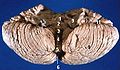 Anterior view of the human cerebellum
 -
 Flocculus
 -
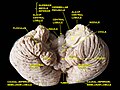 Flocculus
 -
 Flocculus


