Hormone replacement therapy: Difference between revisions
CSV import |
CSV import Tags: mobile edit mobile web edit |
||
| Line 33: | Line 33: | ||
[[Category:Hormones]] | [[Category:Hormones]] | ||
{{Medicine-stub}} | {{Medicine-stub}} | ||
<gallery> | |||
File:Symptoms_of_menopause_(vector).svg|Symptoms of menopause | |||
File:Vaginal_Mucosa_Normal_vs_Menopause.png|Vaginal mucosa normal vs menopause | |||
File:Great_saphenous_vein_thrombosis_05091312009.jpg|Great saphenous vein thrombosis | |||
File:Blausen_0348_EndometrialCancer.png|Endometrial cancer | |||
File:Blausen_0585_IUD.png|Intrauterine device (IUD) | |||
</gallery> | |||
Latest revision as of 04:58, 18 February 2025
Hormone replacement therapy (HRT), also known as menopausal hormone therapy (MHT) or postmenopausal hormone therapy (PHT, PMHT), is a form of therapy that is used to treat symptoms associated with menopause in women.
Overview[edit]
Hormone replacement therapy involves the administration of hormones, typically estrogen and progesterone, to alleviate symptoms of menopause such as hot flashes, night sweats, sleep disturbances, and vaginal dryness. HRT can be administered in various forms, including oral tablets, skin patches, gels, creams, and vaginal rings.
Types of HRT[edit]
There are two main types of hormone replacement therapy:
- Estrogen therapy (ET): This involves the use of estrogen alone, which is typically prescribed for women who have had a hysterectomy.
- Estrogen plus progestogen therapy (EPT): This involves the use of estrogen in combination with progestogen, and is typically prescribed for women who still have their uterus, as the addition of progestogen helps to protect against endometrial cancer.
Benefits and Risks[edit]
While HRT can be effective in treating symptoms of menopause, it also carries potential risks and side effects. The benefits and risks can vary depending on the individual, the type of HRT, the dose and duration of treatment, and whether the hormones are taken cyclically or continuously.
See Also[edit]
References[edit]
<references />

-
 Symptoms of menopause
 -
 Vaginal mucosa normal vs menopause
 -
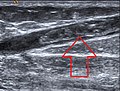 Great saphenous vein thrombosis
 -
 Endometrial cancer
 -
 Intrauterine device (IUD)
.svg)


