Gukbap: Difference between revisions
CSV import |
CSV import |
||
| Line 20: | Line 20: | ||
{{Korea-food-stub}} | {{Korea-food-stub}} | ||
{{food-stub}} | {{food-stub}} | ||
<gallery> | |||
File:Yecheon_Samgang_Jumak.jpg|Yecheon Samgang Jumak | |||
File:Danwon-Jumak.jpg|Danwon Jumak | |||
File:Korean_blood_sausage-Sundae-01.jpg|Korean Blood Sausage Sundae | |||
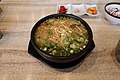
File:Kongnamul_gukbap_20230408_001.jpg|Gukbap | |||
</gallery> | |||
Latest revision as of 04:58, 18 February 2025
Gukbap is a traditional Korean dish that consists of rice served in a hot soup. The name "Gukbap" is derived from two Korean words: "Guk" meaning soup, and "bap" meaning rice. This dish is typically consumed during breakfast or late-night meals and is known for its comforting and hearty qualities.
History[edit]
The origins of Gukbap can be traced back to the Joseon Dynasty, where it was a popular meal among the working class. It was often consumed by merchants and laborers who needed a quick, filling meal during their busy schedules. Over time, Gukbap evolved and diversified, leading to the creation of various regional and seasonal variations.
Preparation and Varieties[edit]
Gukbap is prepared by boiling meat, usually beef or pork, along with vegetables and Korean spices. The soup is then served hot with rice mixed in. There are many variations of Gukbap, each with its unique combination of ingredients. Some of the most popular variations include Sundae-gukbap, which includes Korean blood sausage, and Doenjang-gukbap, which is made with fermented soybean paste.
Cultural Significance[edit]
Gukbap holds a significant place in Korean culture. It is often associated with comfort and home, and is a common dish served during the cold winter months. In addition, Gukbap is also a popular choice for late-night meals, especially among those who have been out drinking as it is believed to help with hangovers.
See Also[edit]

-
 Yecheon Samgang Jumak
 -
 Danwon Jumak
 -
 Korean Blood Sausage Sundae
 -
 Gukbap


