Cricothyroid muscle: Difference between revisions
CSV import Tags: mobile edit mobile web edit |
CSV import Tags: mobile edit mobile web edit |
||
| Line 32: | Line 32: | ||
{{Anatomy-stub}} | {{Anatomy-stub}} | ||
<gallery> | |||
File:Musculuscricothyreoideus.png|Cricothyroid muscle | |||
File:Larynx_external_en.svg|External view of the larynx | |||
File:Gray560.png|Muscles of the larynx, seen from above | |||
File:Gray562.png|Sagittal section of the larynx and upper part of the trachea | |||
File:Gray957.png|The cartilages of the larynx. Posterior view | |||
</gallery> | |||
Latest revision as of 04:58, 18 February 2025
Cricothyroid muscle is a small, but significant muscle located in the neck, playing a crucial role in the modulation of voice by tensing the vocal cords. It is part of the larynx, which is often referred to as the voice box. The cricothyroid muscle is involved in the production of higher-pitched sounds by increasing the tension on the vocal cords.
Anatomy[edit]
The cricothyroid muscle is situated at the front of the larynx, stretching between the cricoid and thyroid cartilage. It is divided into two parts: the pars recta and the pars oblique. The pars recta extends vertically from the anterior aspect of the cricoid cartilage to the inferior margin of the thyroid cartilage, while the pars oblique runs more obliquely.
Innervation[edit]
The cricothyroid muscle is uniquely innervated by the external branch of the superior laryngeal nerve, a branch of the vagus nerve (Cranial nerve X). This nerve supplies the muscle with the motor function required for adjusting the tension of the vocal cords.
Blood Supply[edit]
Blood supply to the cricothyroid muscle is primarily provided by the superior thyroid artery, a branch of the external carotid artery.
Function[edit]
The primary function of the cricothyroid muscle is to lengthen and tense the vocal cords. This action is crucial for the production of high-pitched sounds. When the muscle contracts, it pulls the thyroid cartilage forward relative to the cricoid cartilage, increasing the tension on the vocal cords and thus raising the pitch of the voice.
Clinical Significance[edit]
- Paralysis
Cricothyroid muscle paralysis can result from damage to the external branch of the superior laryngeal nerve. This condition can lead to a loss of ability to produce high-pitched sounds, affecting the quality of the voice.
- Surgery
During thyroidectomy or other neck surgeries, care must be taken to avoid damage to the external branch of the superior laryngeal nerve to preserve the function of the cricothyroid muscle.
See Also[edit]

-
 Cricothyroid muscle
 -
 External view of the larynx
 -
 Muscles of the larynx, seen from above
 -
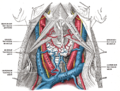 Sagittal section of the larynx and upper part of the trachea
 -
 The cartilages of the larynx. Posterior view


