Proboscis: Difference between revisions
CSV import Tags: mobile edit mobile web edit |
CSV import |
||
| Line 22: | Line 22: | ||
{{stub}} | {{stub}} | ||
== Proboscis == | |||
<gallery> | |||
File:Eristalinus_October_2007-6.jpg|Eristalinus fly with proboscis | |||
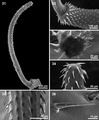
File:Parasite140083-fig5_Figs_31-36_Cathayacanthus_spinitruncatus.tif|Cathayacanthus spinitruncatus proboscis | |||
File:Convolvulus_hawk-moth_(Agrius_convolvuli)_2.jpg|Convolvulus hawk-moth with proboscis | |||
File:Asian_Elephant,_Royal_Chitwan_National_Park.jpg|Asian Elephant with proboscis | |||
</gallery> | |||
Latest revision as of 04:58, 18 February 2025
Proboscis
A Proboscis is an elongated appendage from the head of an animal, either a vertebrate or an invertebrate. In invertebrates, the term usually refers to tubular mouthparts used for feeding and sucking.
Invertebrates[edit]
In many insects, the proboscis is an elongated, flexible organ that some species use to feed on the nectar of flowers. For example, butterflies and moths have a long proboscis that they use to probe flowers for nectar. Some insects, such as mosquitoes and fleas, have a proboscis adapted for piercing the skin of plants or animals to suck their juices or blood.
Vertebrates[edit]
In vertebrates, a proboscis is an elongated nose or snout. The most familiar example is the elephant, which has a long, flexible proboscis that it uses for a variety of tasks, such as gathering food, drinking water, and social interactions.
Other uses[edit]
In some plants, the term "proboscis" is used to refer to long, tubular flowers or other structures that are adapted for pollination by insects with a long proboscis.


_2.jpg)

