Transverse cervical nerve: Difference between revisions
CSV import |
CSV import |
||
| Line 37: | Line 37: | ||
[[Category:Peripheral nervous system]] | [[Category:Peripheral nervous system]] | ||
[[Category:Nerves of the head and neck]] | [[Category:Nerves of the head and neck]] | ||
<gallery> | |||
File:Gray805.png|Transverse cervical nerve | |||
File:Gray804.png|Transverse cervical nerve | |||
File:Gray784.png|Transverse cervical nerve | |||
File:Gray1210.png|Transverse cervical nerve | |||
</gallery> | |||
Latest revision as of 04:57, 18 February 2025
 This article is about the nerve.
   For the artery, see Transverse cervical artery.
The transverse cervical nerve is a cutaneous nerve of the cervical plexus that supplies the skin of the anterior and lateral parts of the neck.
Anatomy[edit]
The transverse cervical nerve arises from the cervical plexus, which is formed by the anterior rami of the first four cervical spinal nerves (C1-C4). Specifically, the transverse cervical nerve originates from the anterior rami of the second and third cervical nerves (C2 and C3).
Course[edit]
The nerve emerges from the posterior border of the sternocleidomastoid muscle, approximately at the midpoint of the muscle. It then curves around the muscle to pass anteriorly and horizontally across the neck. The nerve travels superficially, lying deep to the platysma muscle, and divides into superior and inferior branches.
Branches[edit]
- The superior branch ascends to supply the skin over the anterior triangle of the neck.
- The inferior branch descends to supply the skin over the lateral and anterior parts of the neck.
Function[edit]
The primary function of the transverse cervical nerve is to provide sensory innervation to the skin of the anterior and lateral neck. It is responsible for transmitting sensory information such as touch, pain, and temperature from the skin to the central nervous system.
Clinical significance[edit]
The transverse cervical nerve can be involved in certain medical conditions or procedures. For example, it may be affected in cases of cervical plexus block, a regional anesthesia technique used during surgeries of the neck and shoulder. Injury to the nerve can result in sensory loss or altered sensation in its area of distribution.
Images[edit]


Related pages[edit]
References[edit]
- Standring, S. (2016). Gray's Anatomy: The Anatomical Basis of Clinical Practice. 41st Edition. Elsevier.
- Moore, K. L., Dalley, A. F., & Agur, A. M. R. (2013). Clinically Oriented Anatomy. 7th Edition. Lippincott Williams & Wilkins.
-
 Transverse cervical nerve
 -
 Transverse cervical nerve
 -
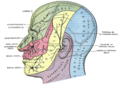 Transverse cervical nerve
 -
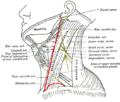 Transverse cervical nerve
