Operculum (botany): Difference between revisions
CSV import Tags: mobile edit mobile web edit |
CSV import |
||
| Line 26: | Line 26: | ||
{{botany-stub}} | {{botany-stub}} | ||
<gallery> | |||
File:Eucalyptus_erythrocorys_operculum.jpg|Eucalyptus erythrocorys operculum | |||
File:Operculum_scar.jpg|Operculum scar | |||
File:Tortula_muralis_kalyptra.jpeg|Tortula muralis calyptra | |||
File:Physcomitrella_Sporophyt.JPG|Physcomitrella sporophyte | |||
</gallery> | |||
Latest revision as of 04:57, 18 February 2025
Operculum (botany) refers to a structure that acts as a lid or covering, found in various plants, particularly in the mosses (Bryophyta) and some members of the flowering plants (Angiosperms). In botany, the term operculum is used to describe a part of the plant that covers an opening, such as the opening of a sporangium or the tip of a flower bud. The primary function of the operculum is to protect the inner structures during development and sometimes to act as a mechanism for releasing spores or pollen when the time is right.
Function and Significance[edit]
The operculum plays a crucial role in the life cycle of plants by providing protection to the reproductive organs or spores. In mosses, the operculum covers the capsule containing spores and is shed when the spores are ready to be dispersed. This mechanism ensures that spores are released in favorable conditions, enhancing the chances of germination and successful colonization of new habitats.
In flowering plants, the operculum can be seen in certain species where it covers the flower bud, protecting the developing flowers from environmental stressors such as pests and harsh weather. Upon maturation, the operculum detaches, allowing the flower to emerge and proceed with the reproductive process.
Examples in Plants[edit]
- In the moss genus Physcomitrium, the operculum is a conspicuous part of the capsule, which pops off to release spores.
- In the Eucalyptus genus, the operculum is a woody structure that covers the flower bud. The term "eucalyptus" itself is derived from Greek words meaning "well" and "cover," referring to the well-covered flower buds. The operculum in eucalyptus falls off as the flower bud matures, allowing the flowers to expand.
Morphology[edit]
The morphology of the operculum varies significantly among different plant species. In mosses, it is typically a small, lid-like structure. In flowering plants, the size, shape, and texture of the operculum can vary widely, depending on the species and the specific function it serves.
Ecological Importance[edit]
The operculum's role in protecting reproductive structures and ensuring successful spore or pollen release is vital for plant reproduction and biodiversity. By facilitating effective spore dispersal, opercula contribute to the ecological success and distribution of mosses. In flowering plants, the operculum's protective function helps in the survival of species in various environmental conditions.
See Also[edit]
-
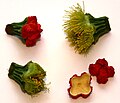 Eucalyptus erythrocorys operculum
 -
 Operculum scar
 -
 Tortula muralis calyptra
 -
 Physcomitrella sporophyte


