Parthenium argentatum: Difference between revisions
CSV import Tags: mobile edit mobile web edit |
CSV import |
||
| Line 25: | Line 25: | ||
[[Category:Rubber plants]] | [[Category:Rubber plants]] | ||
{{Flora-stub}} | {{Flora-stub}} | ||
<gallery> | |||
File:Parthenium_argentatum_(USDA).jpg|Parthenium argentatum plant | |||
File:Manzanar_Relocation_Center,_Manzanar,_California._Guayule_plantings_are_being_inspected_by_Doctor_R_._._._-_NARA_-_538018.jpg|Guayule plantings at Manzanar Relocation Center | |||
File:GuayuleProducts.jpg|Products made from Guayule | |||
</gallery> | |||
Latest revision as of 04:57, 18 February 2025
Parthenium argentatum, also known as the Guayule, is a species of flowering plant in the Asteraceae family. It is native to the southwestern United States and northern Mexico.
Description[edit]
The Parthenium argentatum is a perennial shrub that typically grows to 0.5-1.5 meters in height. The leaves are silver-green, small, and oblong in shape. The plant produces small white flowers in clusters.
Cultivation and uses[edit]
Parthenium argentatum is cultivated for its latex, which can be used as a source of hypoallergenic rubber. The plant is drought-resistant, making it suitable for cultivation in arid regions. The rubber is extracted by a process of crushing and solvent extraction.
History[edit]
The use of Parthenium argentatum for rubber production dates back to the indigenous peoples of Mesoamerica. The plant was later introduced to the United States in the early 20th century as a potential domestic source of rubber.
Research[edit]
Research into the use of Parthenium argentatum for rubber production has increased in recent years due to concerns over the sustainability of traditional rubber sources. The plant's drought resistance and ability to grow in poor soils also make it a promising candidate for sustainable rubber production.
See also[edit]
References[edit]
<references />

This flora-related article is a stub. You can help WikiMD by expanding it.
-
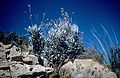 Parthenium argentatum plant
 -
 Guayule plantings at Manzanar Relocation Center
 -
 Products made from Guayule
.jpg)


