Wrist arthroscopy: Difference between revisions
CSV import Tags: mobile edit mobile web edit |
CSV import |
||
| Line 20: | Line 20: | ||
[[Category:Wrist]] | [[Category:Wrist]] | ||
{{medicine-stub}} | {{medicine-stub}} | ||
== Wrist_arthroscopy == | |||
<gallery> | |||
File:Wrist_arthroscopy.png|Wrist arthroscopy procedure | |||
File:Traction_Towe.JPG|Traction tower used in wrist arthroscopy | |||
File:Portals_wrist_arthroscopy.jpg|Portals for wrist arthroscopy | |||
File:Portals_hand.jpg|Portals on hand for wrist arthroscopy | |||
</gallery> | |||
Latest revision as of 04:57, 18 February 2025

Wrist arthroscopy is a surgical procedure used to diagnose and treat problems inside the wrist joint. The term "arthroscopy" comes from two Greek words, arthro (joint) and skopein (to look). Thus, wrist arthroscopy is a procedure that allows surgeons to look inside the wrist joint without making large incisions. This is achieved by using a tiny camera called an arthroscope, which is inserted into the wrist joint through small incisions.
Indications[edit]
Wrist arthroscopy is used for both diagnostic and therapeutic purposes. It can help diagnose unexplained wrist pain, wrist fractures, chronic wrist pain, and symptoms associated with wrist ligament injuries. Therapeutically, it can be used to repair damaged ligaments, remove loose bodies, and treat wrist arthritis and ganglion cysts.
Procedure[edit]
The procedure is usually performed under general anesthesia or regional anesthesia. The surgeon makes small incisions, called portals, in the wrist. The arthroscope is inserted through one of these portals. Other surgical instruments are inserted through the other portals if needed to repair or remove damaged tissue. The advantage of wrist arthroscopy over traditional open surgery is that it involves less pain and a faster recovery time due to the smaller incisions.
Recovery[edit]
Recovery from wrist arthroscopy varies depending on the specific procedure performed. Generally, patients may experience some wrist pain and swelling immediately after the surgery. A splint or bandage may be applied to the wrist to immobilize it and facilitate healing. Physical therapy may be recommended to restore wrist function and strength. Most patients can return to normal activities within a few weeks, although full recovery may take several months.
Risks and Complications[edit]
As with any surgical procedure, wrist arthroscopy carries some risks. These may include infection, damage to nerves or blood vessels, stiffness, and pain at the incision sites. However, these complications are rare, and wrist arthroscopy is considered a safe and effective procedure for diagnosing and treating wrist problems.
Conclusion[edit]
Wrist arthroscopy is a minimally invasive procedure that allows for the detailed examination and treatment of various wrist conditions. Its benefits include reduced pain and quicker recovery times compared to open surgery. Patients considering wrist arthroscopy should discuss the potential risks and benefits with their surgeon.

Wrist_arthroscopy[edit]
-
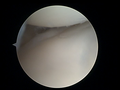 Wrist arthroscopy procedure
 -
 Traction tower used in wrist arthroscopy
 -
 Portals for wrist arthroscopy
 -
 Portals on hand for wrist arthroscopy


