Last universal common ancestor: Difference between revisions
CSV import |
CSV import Tags: mobile edit mobile web edit |
||
| Line 27: | Line 27: | ||
[[Category:Paleoarchean]] | [[Category:Paleoarchean]] | ||
{{evolution-stub}} | {{evolution-stub}} | ||
<gallery> | |||
File:Phylogenetic_tree_of_life_1990_LUCA.svg|Phylogenetic tree of life 1990 LUCA | |||
File:Darwin_Tree_1837.png|Darwin's Tree of Life 1837 | |||
File:LUCA_systems_and_environment.svg|LUCA systems and environment | |||
File:Reduktiver_Acetyl-CoA-Weg.png|Reductive Acetyl-CoA Pathway | |||
File:Tree_Of_Life_(with_horizontal_gene_transfer).svg|Tree of Life with horizontal gene transfer | |||
</gallery> | |||
Latest revision as of 04:56, 18 February 2025
Last Universal Common Ancestor (often abbreviated as LUCA) is the most recent organism from which all organisms now living on Earth have a common descent. LUCA is not thought to be the first living organism on Earth, but only one of many early organisms, where the others have no living descendants.
Characteristics[edit]
LUCA is estimated to have lived some 3.5 to 3.8 billion years ago in the Paleoarchean era. The exact nature of LUCA is not known, nor where it lived. However, it is thought to have been a small, single-celled organism, possibly a prokaryote. It is also thought to have been anaerobic, thermophilic, and chemoautotrophic, meaning it did not require oxygen, was heat-loving, and could make its own food from simple inorganic substances.
Evolutionary History[edit]
The concept of LUCA is based on the theory of evolution, which posits that all life on Earth is connected through common ancestry. This is supported by the genetic code, which is nearly universal, and the central dogma of molecular biology, which describes the basic processes of gene expression common to all life.
LUCA is not a specific organism, but a theoretical entity that represents the "most recent common ancestor" of all current life on Earth. It is the point where the tree of life converges when traced back in time.
Research and Studies[edit]
Research into LUCA is primarily based on studies of genomics and bioinformatics, which involve comparing the genomes of modern organisms to infer characteristics of their common ancestors. In 2016, a team of researchers published a study in which they identified a set of 355 genes that they believe were present in LUCA.
See also[edit]
References[edit]
<references />

-
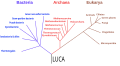 Phylogenetic tree of life 1990 LUCA
 -
 Darwin's Tree of Life 1837
 -
 LUCA systems and environment
 -
 Reductive Acetyl-CoA Pathway
 -
 Tree of Life with horizontal gene transfer


.svg)
