Isopenicillin N synthase: Difference between revisions
CSV import |
CSV import |
||
| Line 29: | Line 29: | ||
{{enzyme-stub}} | {{enzyme-stub}} | ||
== Isopenicillin N synthase == | |||
<gallery> | |||
File:IPNS_RIBBON.JPG|Ribbon structure of Isopenicillin N synthase | |||
File:ACTIVE_SITE_Isopenicillin-N_synthase.JPG|Active site of Isopenicillin N synthase | |||
File:IPNS_active_site1.gif|Active site of Isopenicillin N synthase | |||
File:IPNS_mechanism.gif|Mechanism of Isopenicillin N synthase | |||
File:Antibiotic_formation_pathway.svg|Antibiotic formation pathway involving Isopenicillin N synthase | |||
</gallery> | |||
Latest revision as of 04:53, 18 February 2025
Isopenicillin N synthase (IPNS) is an enzyme crucial in the biosynthesis of penicillin and cephalosporin antibiotics. This enzyme catalyzes the cyclization of the linear tripeptide δ-(L-α-aminoadipyl)-L-cysteinyl-D-valine (ACV) into isopenicillin N (IPN), a critical step in the biosynthetic pathway of β-lactam antibiotics. The activity of IPNS is a pivotal process in the production of penicillin and cephalosporin, which are among the most widely used antibiotics for the treatment of bacterial infections.
Function[edit]
Isopenicillin N synthase operates by facilitating the formation of the four-membered β-lactam ring, characteristic of penicillins and cephalosporins, from the linear ACV tripeptide. This reaction involves the oxidative cyclization of ACV, with the enzyme utilizing iron(II) as a cofactor and molecular oxygen (O2) as a co-substrate. The product, isopenicillin N, serves as a core structure for further enzymatic modifications leading to a variety of penicillin and cephalosporin antibiotics.
Structure[edit]
The structure of IPNS is characterized by its iron-binding active site, where the iron ion is coordinated by two histidine residues and one carboxylate residue. This coordination is essential for the enzyme's catalytic activity. The enzyme's structure has been elucidated through X-ray crystallography, revealing insights into its mechanism of action and facilitating the design of inhibitors and the engineering of enzymes with improved properties for industrial applications.
Biotechnological Applications[edit]
The understanding of IPNS function and structure has significant implications for the biotechnological production of β-lactam antibiotics. Genetic engineering techniques have been employed to increase the yield of IPN by overexpressing IPNS in Penicillium and Aspergillus species, which are fungi used in the industrial production of antibiotics. Additionally, the manipulation of IPNS genes in these organisms can lead to the production of novel antibiotics with improved pharmacological properties.
Clinical Significance[edit]
The antibiotics produced through the IPNS pathway are critical in the treatment of a wide range of bacterial infections. Resistance to β-lactam antibiotics, however, poses a significant challenge to their clinical efficacy. Understanding the mechanism of action and the structure of IPNS offers potential avenues for the development of new inhibitors to overcome antibiotic resistance.
See Also[edit]
References[edit]
<references/>
This article is a enzyme-related stub. You can help WikiMD by expanding it!
Isopenicillin N synthase[edit]
-
Ribbon structure of Isopenicillin N synthase
-
 Active site of Isopenicillin N synthase
 -
 Active site of Isopenicillin N synthase
 -
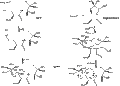 Mechanism of Isopenicillin N synthase
 -
 Antibiotic formation pathway involving Isopenicillin N synthase


