Cellana exarata: Difference between revisions
CSV import Tags: mobile edit mobile web edit |
CSV import |
||
| Line 28: | Line 28: | ||
{{Hawaii-stub}} | {{Hawaii-stub}} | ||
{{food-stub}} | {{food-stub}} | ||
<gallery> | |||
File:Cellana_exarata_002.jpg|Cellana exarata | |||
File:Limpet_(PSF).png|Limpet | |||
File:Saltwater_Limpet_Diagram-en.svg|Saltwater Limpet Diagram | |||
File:Naturalis_Biodiversity_Center_-_RMNH.MOL.137702_-_Cellana_exarata_(Reeve,_1854)_-_Nacellidae_-_Mollusc_shell.jpeg|Cellana exarata (Reeve, 1854) - Mollusc shell | |||
File:Cellana_exarata_001.jpg|Cellana exarata | |||
</gallery> | |||
Latest revision as of 04:52, 18 February 2025
Cellana exarata, also known as the Hawaiian Blackfoot ʻopihi, is a species of true limpet, a group of marine gastropod mollusks in the family Nacellidae. This species is endemic to the Hawaiian Islands, where it is a significant part of the local marine ecology and human culture.
Description[edit]
Cellana exarata is a medium-sized limpet with a shell that is typically 35-50 mm in length. The shell is conical and the color varies from black to brown. The interior of the shell is white with a blue or green hue.
Habitat and Distribution[edit]
The Hawaiian Blackfoot ʻopihi is found exclusively in the Hawaiian Islands. It inhabits the intertidal zone, particularly on wave-exposed rocky shores. The species is most abundant on the windward coasts of the islands.
Ecology[edit]
Cellana exarata is a herbivore, feeding primarily on algae that it scrapes off the rocks with its radula. It is a key species in the intertidal ecosystem, influencing the distribution and abundance of algae on the rocks where it feeds.
Human Use[edit]
The Hawaiian Blackfoot ʻopihi is a traditional food source for Native Hawaiians, who collect the limpets from the rocks at low tide. The species is also used in jewelry making.
Conservation[edit]
Cellana exarata is not currently listed as threatened or endangered. However, overharvesting and habitat loss due to coastal development pose potential threats to the species.
See Also[edit]
.png)


-
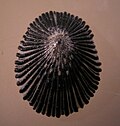 Cellana exarata
 -
 Limpet
 -
 Saltwater Limpet Diagram
 -
 Cellana exarata (Reeve, 1854) - Mollusc shell
 -
 Cellana exarata

.png)

_-_Nacellidae_-_Mollusc_shell.jpeg)

