Superheater: Difference between revisions
CSV import Tags: mobile edit mobile web edit |
CSV import |
||
| Line 41: | Line 41: | ||
{{Thermodynamics-stub}} | {{Thermodynamics-stub}} | ||
<gallery> | |||
File:PowerStation2.svg|Diagram of a power station | |||
File:Superheater.jpg|Superheater | |||
File:Superheater-front.jpg|Front view of a superheater | |||
File:Prokudin-Gorskii-26.jpg|Historical photograph by Prokudin-Gorskii | |||
</gallery> | |||
Latest revision as of 04:51, 18 February 2025
Superheater
A superheater is a device found in steam engines that heats the steam generated by the boiler, again increasing its thermal energy and significantly reducing the likelihood of condensation inside the engine. Superheaters increase the efficiency of the steam engine, and have been widely used in steam locomotives, ships, and stationary steam engines. This component is also crucial in the operation of steam turbines used in electric power generation.
Overview[edit]
The primary function of a superheater is to increase the temperature of the steam produced by the boiler beyond the saturation temperature. This process, known as superheating, turns wet steam into dry or superheated steam. Superheated steam has a higher thermal energy, which makes the steam engine or turbine more efficient, reducing the overall fuel consumption.
Types of Superheaters[edit]
Superheaters can be classified into two main types based on their construction and the method of steam flow:
1. Convection Superheaters: These are placed in the path of the hot gases from the boiler to utilize the heat from these gases to increase the temperature of the steam. 2. Radiant Superheaters: They are located in the combustion chamber and use direct radiation from the fire to heat the steam.
Applications[edit]
Superheated steam has several advantages in various applications, including:
- Steam Locomotives: Superheaters are an essential part of steam locomotives, providing a significant improvement in efficiency and power. - Power Generation: In power plants, superheated steam is used to drive turbines, which generate electricity. The higher the steam temperature, the more efficient the turbine. - Industrial Processes: Many industrial processes require the high-temperature steam provided by superheaters for processes such as dyeing, paper manufacturing, and chemical processing.
Advantages[edit]
The use of superheated steam offers numerous benefits:
- Increased efficiency of steam engines and turbines. - Reduced condensation losses in the steam engine cylinders and turbines. - Improved fuel efficiency and reduced operational costs. - Enhanced capacity for power generation.
Maintenance and Challenges[edit]
Maintaining a superheater is crucial for the efficient operation of steam engines and turbines. Challenges include:
- High-temperature corrosion and material degradation. - Scaling and fouling, which can reduce heat transfer efficiency. - Mechanical stress and thermal fatigue due to temperature fluctuations.
Conclusion[edit]
Superheaters play a vital role in enhancing the efficiency and performance of steam engines and turbines. By increasing the temperature of steam beyond its saturation point, superheaters enable the more efficient use of steam in power generation, locomotion, and various industrial processes.

This article is a thermodynamics-related stub. You can help WikiMD by expanding it!
-
 Diagram of a power station
 -
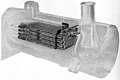 Superheater
 -
 Front view of a superheater
 -
 Historical photograph by Prokudin-Gorskii


