Viper: Difference between revisions
CSV import |
CSV import Tags: mobile edit mobile web edit |
||
| Line 28: | Line 28: | ||
{{stub}} | {{stub}} | ||
<gallery> | |||
File:Viperidae-01.jpg|Viper | |||
File:Crotalus_skull.jpg|Crotalus skull | |||
File:Arabian_Horned_viper.jpg|Arabian Horned Viper | |||
File:Vipera_berus_in_Finland.jpg|Vipera berus in Finland | |||
File:(Westliche_Diamantklapperschlange)_Crotalus_atrox.jpg|Western Diamondback Rattlesnake | |||
</gallery> | |||
Latest revision as of 04:51, 18 February 2025
Viper is a family of venomous snakes found in most parts of the world, with the exception of Antarctica, Australia, Hawaii, Madagascar, various other isolated islands, and north of the Arctic Circle. All have relatively long, hinged fangs that permit deep penetration and injection of snake venom. Vipers are considered to be among the most advanced of all snake groups.
Taxonomy and etymology[edit]
The name Viper is derived from the Latin word vipera, which means "viper". The family Viperidae includes three subfamilies: Viperinae (the true vipers), Crotalinae (the pit vipers), and Azemiopinae.
Characteristics[edit]
Vipers are known for their venomous bite. They have a pair of long, hollow fangs that they use to inject venom into their prey. These fangs are connected to venom glands located in the upper part of the mouth. When a viper bites, it can control the amount of venom it injects.
Distribution and habitat[edit]
Vipers are found in a wide range of habitats, including deserts, forests, and mountains. They are most common in the tropics, but can also be found in temperate regions.
Behavior[edit]
Vipers are primarily nocturnal and are known for their ambush hunting tactics. They typically wait for prey to come within striking distance before launching a rapid, accurate strike.
Venom[edit]
The venom of vipers is primarily used for immobilizing prey and for defense against predators. The venom contains a variety of compounds, including enzymes and toxins, that cause pain, swelling, and sometimes death in the victim.
Conservation[edit]
Many species of vipers are threatened by habitat loss, persecution, and over-collection for the pet trade. Conservation efforts for vipers include habitat protection, regulation of collection, and public education about the importance of these snakes in the ecosystem.
See also[edit]
 |
 |
-
 Viper
Viper -
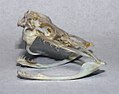 Crotalus skull
 -
 Arabian Horned Viper
 -
 Vipera berus in Finland
 -
 Western Diamondback Rattlesnake


_Crotalus_atrox.jpg)

