John Stuart Mill: Difference between revisions
CSV import |
CSV import |
||
| Line 25: | Line 25: | ||
[[Category:Members of Parliament]] | [[Category:Members of Parliament]] | ||
[[Category:British Personalities]] | [[Category:British Personalities]] | ||
<gallery> | |||
File:John_Stuart_Mill_by_London_Stereoscopic_Company,_c1870.jpg|John Stuart Mill by London Stereoscopic Company, c. 1870 | |||
File:J_S_Mill_and_H_Taylor.jpg|John Stuart Mill and Harriet Taylor | |||
File:John_Stuart_Mill,_Vanity_Fair,_1873-03-29.jpg|John Stuart Mill, Vanity Fair, 1873 | |||
File:JohnStuartMill.jpg|John Stuart Mill | |||
File:Mill_-_Essays_on_economics_and_society,_1967_-_5499347.tif|Essays on Economics and Society, 1967 | |||
</gallery> | |||
Latest revision as of 04:49, 18 February 2025
John Stuart Mill (20 May 1806 – 8 May 1873) was a British philosopher, political economist, civil servant, and Member of Parliament who is widely regarded as one of the most influential thinkers in the history of liberalism. He contributed extensively to social theory, political theory, and political economy. Mill's conception of liberty justified the freedom of the individual in opposition to unlimited state and social control.
Early life and education[edit]
Mill was born in Pentonville, London, the eldest son of the Scottish philosopher, historian, and economist James Mill. He was educated exclusively by his father, who was a strict disciplinarian. By the age of three, Mill was taught Greek and by the age of eight, Latin, alongside English, arithmetic, and history.
Career[edit]
Mill followed his father into a career at the East India Company until its abolition in 1858. He was also an influential figure in the British Parliament, advocating for liberal policies such as women's suffrage and labor rights.
Philosophical views[edit]
Mill's most famous work, On Liberty, argues for the protection of individual freedom against state interference and societal opinion. He also wrote extensively on utilitarianism, a moral theory that evaluates actions based on their consequences for overall happiness and well-being.
Personal life[edit]
Mill was married to Harriet Taylor Mill, a significant influence on his work and ideas. After her death, Mill spent the rest of his life promoting her ideas and ensuring her contributions to his work were recognized.
Legacy[edit]
Mill's ideas have had a profound influence on liberalism, political theory, and economics. His works continue to be studied and debated by scholars and students around the world.


-
 John Stuart Mill by London Stereoscopic Company, c. 1870
 -
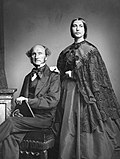 John Stuart Mill and Harriet Taylor
 -
 John Stuart Mill, Vanity Fair, 1873
 -
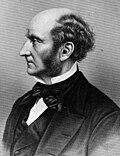 John Stuart Mill
 -
 Essays on Economics and Society, 1967


