Thioredoxin reductase: Difference between revisions
CSV import Tags: mobile edit mobile web edit |
CSV import |
||
| Line 29: | Line 29: | ||
{{Medicine-stub}} | {{Medicine-stub}} | ||
<gallery> | |||
File:CellularTrxR.png|Thioredoxin_reductase | |||
File:EcoliTrxRwithBoundThioredoxin.png|E. coli Thioredoxin Reductase with Bound Thioredoxin | |||
File:EcoliTrxRProstheticGroups.png|E. coli Thioredoxin Reductase Prosthetic Groups | |||
File:HumanThxRProstheticGroups.png|Human Thioredoxin Reductase Prosthetic Groups | |||
File:HumanTrxRRxnMech.jpg|Human Thioredoxin Reductase Reaction Mechanism | |||
</gallery> | |||
Latest revision as of 04:48, 18 February 2025
Thioredoxin reductase is an enzyme that plays a crucial role in the regulation of cellular redox processes. It is part of the thioredoxin system, which also includes thioredoxin and NADPH, and is involved in the reduction of thioredoxin, thereby contributing to a wide range of cellular processes including DNA synthesis, repair, and the regulation of transcription factors. Thioredoxin reductase is encoded by the genes TXNRD1, TXNRD2, and TXNRD3 in humans, corresponding to the three isoforms of the enzyme: cytosolic, mitochondrial, and testis-specific, respectively.
Function[edit]
Thioredoxin reductase catalyzes the NADPH-dependent reduction of thioredoxin, thus playing a key role in maintaining a reduced environment in the cell. This activity is essential for the antioxidant defense and for the regulation of various cellular processes, including cell growth, apoptosis, and the response to oxidative stress. The enzyme is also involved in the reduction of other substrates, such as vitamin C, hydrogen peroxide, and certain transcription factors, further underscoring its importance in cellular redox homeostasis.
Structure[edit]
The enzyme exists as a homodimer, with each subunit containing a FAD domain and a NADPH domain. The active site of thioredoxin reductase contains a selenocysteine residue, which is essential for its catalytic activity. This unique feature distinguishes it from other reductases and is a key factor in its high reactivity and broad substrate specificity.
Isoforms[edit]
In humans, there are three main isoforms of thioredoxin reductase:
- Thioredoxin reductase 1 (TXNRD1) - the cytosolic form, which is ubiquitously expressed and plays a general role in cellular redox regulation.
- Thioredoxin reductase 2 (TXNRD2) - the mitochondrial form, which is crucial for the maintenance of mitochondrial redox status and energy production.
- Thioredoxin reductase 3 (TXNRD3) - the testis-specific form, which is thought to play a role in spermatogenesis.
Clinical Significance[edit]
Thioredoxin reductase is implicated in various diseases due to its role in maintaining cellular redox balance. Its overexpression has been observed in several types of cancer, suggesting a potential role in tumorigenesis. Inhibitors of thioredoxin reductase are being explored as anticancer agents. Additionally, the enzyme's involvement in the antioxidant defense system makes it a target for therapeutic interventions in diseases characterized by oxidative stress, such as cardiovascular diseases and neurodegenerative disorders.
Inhibitors[edit]
Several compounds have been identified as inhibitors of thioredoxin reductase, including auranofin, a drug used in the treatment of rheumatoid arthritis, and various organotin compounds. These inhibitors have potential therapeutic applications in cancer treatment by disrupting the redox balance within cancer cells.
See Also[edit]

-
 Thioredoxin_reductase
 -
 E. coli Thioredoxin Reductase with Bound Thioredoxin
 -
 E. coli Thioredoxin Reductase Prosthetic Groups
 -
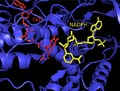 Human Thioredoxin Reductase Prosthetic Groups
 -
 Human Thioredoxin Reductase Reaction Mechanism


