Veterans Health Administration: Difference between revisions
CSV import Tags: mobile edit mobile web edit |
CSV import |
||
| Line 29: | Line 29: | ||
{{US-gov-stub}} | {{US-gov-stub}} | ||
<gallery> | |||
File:US_Veterans_Health_Administration_logo_stacked.png|Veterans Health Administration Logo | |||
File:VA_2015-2019_Health_Programs_Budget_Allocation.png|VA 2015-2019 Health Programs Budget Allocation | |||
File:VHA_VISN_Map.gif|VHA VISN Map | |||
File:VAID_Obverse.png|VA Identification Card Obverse | |||
File:Veterans_Petersburg_Clinic_2020.jpg|Veterans Petersburg Clinic 2020 | |||
</gallery> | |||
Latest revision as of 04:45, 18 February 2025
Veterans Health Administration (VHA)
The Veterans Health Administration (VHA) is a component of the United States Department of Veterans Affairs (VA) led by the Under Secretary of Veterans Affairs for Health. It is the largest integrated health care system in the United States, providing care at 1,255 health care facilities, including 170 VA Medical Centers and 1,074 outpatient sites of care of varying complexity (VHA outpatient clinics) to over 9 million Veterans enrolled in the VA health care program.
History[edit]
The VHA has its roots in the establishment of the National Home for Disabled Volunteer Soldiers following the Civil War in 1865. It was created to provide care for the nation's veterans, including medical, surgical, and rehabilitative services. Over the years, the system has evolved and expanded significantly. In 1946, the Hospital Survey and Construction Act (also known as the Hill-Burton Act) was passed, leading to the construction of new VA hospitals. The VHA as it is known today was officially established in 1996, with the goal of providing federally funded health care benefits to veterans and their families.
Services[edit]
The VHA offers a broad range of medical, surgical, and rehabilitative care. Its services include, but are not limited to, primary care, specialized care, mental health services, inpatient care, long-term care, and prescription medications. The VHA also provides support for the homeless and substance abuse programs, prosthetics, orthopedics, and geriatrics.
Eligibility[edit]
Eligibility for VHA services is determined by factors such as service in the military, the nature of the discharge received, and the length of service. Veterans must apply for enrollment in the VA health care system to receive benefits. Priority groups have been established to ensure that certain groups of veterans receive immediate care.
Challenges and Criticisms[edit]
The VHA has faced various challenges and criticisms over the years, including long wait times for appointments, concerns over the quality of care, and issues with the management and operation of VA facilities. In response, the VA has implemented several reforms aimed at improving access to care, enhancing the quality of services, and increasing accountability.
Recent Developments[edit]
In recent years, the VHA has focused on modernizing its services and infrastructure, including the adoption of electronic health records and telehealth services. These efforts aim to improve patient care and access, particularly for veterans living in rural or remote areas.
See Also[edit]
- United States Department of Veterans Affairs
- VA Medical Center
- Post-9/11 Veterans Educational Assistance Act of 2008
- GI Bill
.svg)
-
 Veterans Health Administration Logo
 -
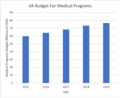 VA 2015-2019 Health Programs Budget Allocation
 -
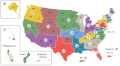 VHA VISN Map
 -
 VA Identification Card Obverse
 -
 Veterans Petersburg Clinic 2020


