Chrysomya putoria: Difference between revisions
CSV import |
CSV import |
||
| Line 25: | Line 25: | ||
[[Category:Public health]] | [[Category:Public health]] | ||
{{medicine-stub}} | {{medicine-stub}} | ||
<gallery> | |||
File:Close-up_of_Chrysomya_(Old_World_blow_fly)_on_a_green_leaf.jpg|Close-up of Chrysomya on a green leaf | |||
File:San_Ramón,_Chanchamayo,_Junín._08.jpg|Chrysomya putoria | |||
File:Chrysomya_albiceps_eating.jpg|Chrysomya albiceps eating | |||
File:Miasis_human.jpg|Miasis human | |||
</gallery> | |||
Latest revision as of 04:44, 18 February 2025
Chrysomya putoria is a species of blowfly found in many parts of the world, particularly in tropical and subtropical regions. It is a member of the family Calliphoridae, which includes other species of flies that are significant in both medical and forensic contexts. Chrysomya putoria is of particular interest due to its role in forensic entomology, as well as its impact on public health and livestock.
Description[edit]
Chrysomya putoria is distinguishable by its metallic green or blue coloration, with the adult flies typically measuring between 6 to 12 mm in length. Like other species in the genus Chrysomya, it has a set of distinctive black stripes on its thorax and a checkerboard pattern on its abdomen. The larvae, or maggots, of C. putoria are creamy white in color and can reach up to 12 mm in length at their final larval stage.
Habitat and Distribution[edit]
C. putoria is predominantly found in warmer climates, thriving in both rural and urban settings. Its distribution spans across Africa, Asia, and Latin America. The species prefers environments where decaying organic matter is present, as this serves as a food source for the larvae. This includes garbage dumps, open wounds, and dead animals, making it a species of concern for both human and animal health.
Life Cycle[edit]
The life cycle of Chrysomya putoria is similar to that of other blowflies and is characterized by four stages: egg, larva, pupa, and adult. The female fly lays eggs in decaying organic matter, which hatch into larvae within 24 hours. The larval stage, which involves three molts, can last from 4 to 10 days, depending on environmental conditions. Following the larval stage, the larvae pupate, emerging as adults after 6 to 10 days. The entire life cycle can be completed in as little as 2 weeks under optimal conditions.
Medical and Forensic Importance[edit]
Chrysomya putoria plays a significant role in forensic entomology, where it is used to estimate the post-mortem interval (PMI) in cases of suspicious death. The presence of C. putoria larvae on a corpse can provide forensic investigators with valuable information regarding the time of death, based on the developmental stage of the larvae.
In addition to its forensic applications, C. putoria is also of medical concern due to its association with myiasis, a condition where fly larvae infest living tissue. This can occur in livestock, leading to economic losses, as well as in humans, particularly in those with compromised health or living in unsanitary conditions.
Control and Prevention[edit]
Controlling the population of Chrysomya putoria involves sanitation measures to reduce the availability of breeding sites. This includes proper disposal of garbage and animal carcasses, as well as maintaining clean and hygienic conditions in areas where livestock are kept. In cases of myiasis, prompt medical treatment is necessary to remove the larvae and treat the affected tissue.
Conclusion[edit]
Chrysomya putoria is a species with significant implications for public health, veterinary medicine, and forensic science. Understanding its biology and behavior is crucial for managing its impact on human and animal populations, as well as for utilizing its larvae in the field of forensic entomology.

-
 Close-up of Chrysomya on a green leaf
 -
 Chrysomya putoria
 -
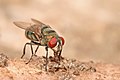 Chrysomya albiceps eating
 -
 Miasis human
_on_a_green_leaf.jpg)


