Single-electron transistor: Difference between revisions
CSV import |
CSV import |
||
| Line 36: | Line 36: | ||
{{Electronics-stub}} | {{Electronics-stub}} | ||
<gallery> | |||
File:SET_schematic2.jpg|Schematic of a single-electron transistor | |||
File:Set_schematic.svg|Diagram of a single-electron transistor | |||
File:Single_electron_transistor.svg|Illustration of a single-electron transistor | |||
File:TySETimage.png|Image of a single-electron transistor | |||
File:SETFET_schematic.jpg|Schematic of a SETFET | |||
</gallery> | |||
Latest revision as of 04:40, 18 February 2025
Single-electron transistor (SET) is a type of switching device that utilizes controlled electron tunneling to amplify current. SETs are key components in the field of nanoelectronics, offering high sensitivity and the potential for integration into quantum computing circuits. The operation of a single-electron transistor is based on the Coulomb blockade effect, which allows the device to control the flow of individual electrons through a barrier.
Principle of Operation[edit]
The single-electron transistor consists of a small conducting island connected to two electrodes (source and drain) through tunnel junctions and controlled by a gate electrode. The island is so small that adding an extra electron significantly changes its potential energy, a phenomenon described by the Coulomb blockade. The gate voltage influences the energy levels of the island, enabling the control of electron tunneling between the source and drain. This process allows the SET to operate as a transistor, with the gate voltage modulating the current flow.
Fabrication[edit]
Fabrication of SETs involves advanced nanofabrication techniques such as electron beam lithography (EBL), which allows for the precise patterning required for the small dimensions of the SET components. Materials commonly used in SET construction include metals like aluminum for the island and tunnel junctions, and silicon or graphene for the substrate.
Applications[edit]
Single-electron transistors have potential applications in various fields, including:
- Quantum computing: SETs can be used to read out qubits, making them integral to quantum computing architectures.
- Sensors: Due to their high sensitivity to electrical charge, SETs are excellent candidates for use in ultra-sensitive charge detectors.
- Digital electronics: SETs offer the possibility of ultra-low power consumption, which is beneficial for future digital electronics aiming to reduce energy usage.
Challenges[edit]
Despite their potential, the practical application of single-electron transistors faces several challenges:
- Temperature: SET operations are often limited to cryogenic temperatures, restricting their use in everyday electronics.
- Fabrication variability: The precise control required in the fabrication process can lead to variability in device characteristics.
- Integration: Integrating SETs with existing semiconductor technologies poses significant challenges due to their nanoscale dimensions and sensitivity to environmental factors.
Future Directions[edit]
Research in single-electron transistors continues to focus on overcoming the existing limitations, with efforts aimed at:
- Developing new materials and fabrication techniques to enable operation at higher temperatures.
- Enhancing the reliability and reproducibility of SET devices.
- Integrating SETs with other nanoelectronic components to create more complex circuits and systems.
See Also[edit]

-
 Schematic of a single-electron transistor
 -
 Diagram of a single-electron transistor
 -
 Illustration of a single-electron transistor
 -
 Image of a single-electron transistor
 -
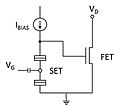 Schematic of a SETFET


