Evolution of sexual reproduction: Difference between revisions
CSV import |
CSV import Tags: mobile edit mobile web edit |
||
| Line 22: | Line 22: | ||
[[Category:Evolutionary Biology]] | [[Category:Evolutionary Biology]] | ||
[[Category:Genetics]] | [[Category:Genetics]] | ||
== Evolution of sexual reproduction == | |||
<gallery> | |||
File:Ladybird-Coccinellidae-mating.jpg|Ladybirds mating | |||
File:2012-04-03_16-43-53-amaryllis-sp.jpg|Amaryllis flower | |||
File:Evolsex-dia2a.svg|Diagram of sexual reproduction evolution | |||
File:Evolsex-dia1a.svg|Diagram of sexual reproduction evolution | |||
File:Synergistic_versus_antagonistic_epistasis.svg|Synergistic versus antagonistic epistasis | |||
</gallery> | |||
Latest revision as of 04:38, 18 February 2025
Evolution of Sexual Reproduction is a significant topic in the field of biological sciences, specifically in the areas of evolutionary biology and genetics. The process of sexual reproduction, which involves the combination of genetic material from two parent organisms to create offspring, has evolved over billions of years. This article will explore the evolutionary origins and advantages of sexual reproduction, as well as the theories and hypotheses that have been proposed to explain its prevalence in nature.
Origins of Sexual Reproduction[edit]
The origins of sexual reproduction are traced back to the early prokaryotic organisms. These organisms reproduced asexually through binary fission, a process in which a single cell divides into two identical cells. However, over time, some prokaryotes developed the ability to exchange genetic material through a process known as horizontal gene transfer, which is considered a precursor to sexual reproduction.
Advantages of Sexual Reproduction[edit]
Sexual reproduction offers several evolutionary advantages over asexual reproduction. One of the primary benefits is genetic variation, which increases the chances of survival for a species in changing environments. This is achieved through the process of meiosis, where the combination of genetic material from two parents results in offspring with unique genetic compositions.
Theories and Hypotheses[edit]
Several theories and hypotheses have been proposed to explain the evolution of sexual reproduction. The Red Queen Hypothesis suggests that sexual reproduction evolved as a means to keep up with constantly evolving parasites. The Muller's Ratchet theory proposes that sexual reproduction helps to eliminate harmful mutations from a population. The Lottery Principle suggests that sexual reproduction provides a survival advantage in unpredictable environments.
Conclusion[edit]
The evolution of sexual reproduction is a complex process that has shaped the diversity and survival of species on Earth. While the exact mechanisms and reasons for its evolution are still a subject of ongoing research, it is clear that sexual reproduction plays a crucial role in the survival and evolution of species.

Evolution of sexual reproduction[edit]
-
 Ladybirds mating
 -
 Amaryllis flower
 -
 Diagram of sexual reproduction evolution
 -
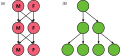 Diagram of sexual reproduction evolution
 -
 Synergistic versus antagonistic epistasis


