Vitelotte: Difference between revisions
CSV import Tags: mobile edit mobile web edit |
CSV import |
||
| Line 23: | Line 23: | ||
[[Category:French cuisine]] | [[Category:French cuisine]] | ||
{{food-stub}} | {{food-stub}} | ||
<gallery> | |||
File:Vitelotte.jpg|Vitelotte | |||
File:PurplePeruvianPotatoes.jpg|Purple Peruvian Potatoes | |||
File:Pic3.Vitelotte.jpg|Vitelotte | |||
File:Blaue_Chips_Schüssel.jpg|Blaue Chips Schüssel | |||
File:Vitelotte-potato-leaves.jpg|Vitelotte Potato Leaves | |||
</gallery> | |||
Latest revision as of 04:38, 18 February 2025
Vitelotte, also known as Vitelotte Noire, Truffe de Chine or Négresse, is a gourmet potato variety that is native to France. It is known for its unique deep violet or dark blue skin and flesh. The Vitelotte is a heritage variety of potato that has been cultivated in France since the early 19th century.
History[edit]
The Vitelotte potato was first cultivated in France in the early 19th century. It is believed to have been introduced to Europe by Spanish conquistadors who brought it back from South America. The name "Vitelotte" is derived from the French words "vite" (quickly) and "lotte" (hidden), referring to the potato's ability to quickly disappear when cooked due to its small size and dark color.
Characteristics[edit]
Vitelotte potatoes are small to medium in size, with an elongated and irregular shape. They have a deep violet or dark blue skin and flesh, which retains its color even after cooking. The potatoes have a dense texture and a nutty flavor, similar to chestnuts. They are rich in antioxidants, particularly anthocyanins, which give them their distinctive color.
Culinary Uses[edit]
Vitelotte potatoes can be used in a variety of dishes. They are often boiled, baked, or fried, and can be used to make colorful salads, soups, and side dishes. They are also used in the preparation of French fries and chips, where their unique color can add a visual appeal to the dish. In France, they are often served with fish or meat dishes, and are a popular ingredient in the traditional French dish, gratin dauphinois.
Cultivation[edit]
Vitelotte potatoes are typically grown in cooler climates, and are harvested in the late summer or early fall. They are a relatively hardy variety, and can be stored for several months in a cool, dark place. They are typically planted in the spring, and require well-drained soil and regular watering to thrive.
See Also[edit]
References[edit]
<references />

-
 Vitelotte
 -
 Purple Peruvian Potatoes
 -
 Vitelotte
 -
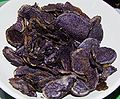 Blaue Chips Schüssel
 -
 Vitelotte Potato Leaves


