Bohr model: Difference between revisions
CSV import |
CSV import Tags: mobile edit mobile web edit |
||
| Line 27: | Line 27: | ||
[[Category:Quantum Mechanics]] | [[Category:Quantum Mechanics]] | ||
{{Physics-stub}} | {{Physics-stub}} | ||
<gallery> | |||
File:Bohr_atom_model.svg|Bohr model of the atom | |||
File:Atome_bohr_couches_electroniques_KLM.svg|Bohr electron shells KLM | |||
File:Blausen_0342_ElectronEnergyLevels.png|Electron energy levels | |||
File:Sommerfeld_ellipses.svg|Sommerfeld ellipses | |||
File:US_Atomic_Energy_Commission_logo.jpg|Bohr model | |||
</gallery> | |||
Latest revision as of 04:37, 18 February 2025

Bohr Model is a theory for the hydrogen atom based on quantum theory that energy is transferred only in certain well defined quantities. It was proposed by Danish physicist Niels Bohr in 1913. The model explains how electrons can have stable orbits around the nucleus and why atoms emit light in fixed wavelengths.
Background[edit]
Before the Bohr Model, the atom was thought to be a plum pudding model, with electrons within a positively charged "soup." After the discovery of the nucleus by Ernest Rutherford, it was clear that a new model was needed. Bohr's work built upon Rutherford's findings and the quantized nature of energy proposed by Max Planck and Albert Einstein's explanation of the photoelectric effect.
Postulates of the Bohr Model[edit]
The Bohr Model is based on three fundamental postulates:
- Electrons orbit the nucleus in orbits that have quantized angular momenta. These orbits are stable and called stationary states.
- Electrons can move from one orbit to another by absorbing or emitting a photon whose energy equals the difference between the orbits.
- The energy levels of the electrons are quantized, and the quantization is given by the formula \(E_n = -\frac{R_H}{n^2}\), where \(E_n\) is the energy of the nth level, \(R_H\) is the Rydberg constant for hydrogen, and \(n\) is the principal quantum number.
Implications and Limitations[edit]
The Bohr Model successfully explained the spectral lines of the hydrogen atom and provided a stepping stone for the development of quantum mechanics. However, it could not explain the spectra of atoms heavier than hydrogen or the fine structure and splitting of spectral lines observed under a magnetic field (Zeeman effect).
Legacy[edit]
Despite its limitations, the Bohr Model represents a significant milestone in the development of atomic physics. It introduced the concept of quantization in the structure of the atom, which was a radical departure from classical physics. The model paved the way for the development of the quantum mechanical model of the atom, which could address the deficiencies of the Bohr Model.
See Also[edit]

-
 Bohr model of the atom
 -
 Bohr electron shells KLM
 -
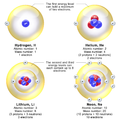 Electron energy levels
 -
 Sommerfeld ellipses
 -
 Bohr model


