Succinyl coenzyme A synthetase: Difference between revisions
CSV import |
CSV import |
||
| Line 31: | Line 31: | ||
[[Category:Metabolism]] | [[Category:Metabolism]] | ||
{{Enzyme-stub}} | {{Enzyme-stub}} | ||
<gallery> | |||
File:2fp4.png|Succinyl Coenzyme A Synthetase structure | |||
File:2scu.png|Succinyl Coenzyme A Synthetase complex | |||
File:Succinyl_CoA_Synthetase_Mechanism_Revised.png|Succinyl Coenzyme A Synthetase mechanism | |||
File:SCS_heterotetramer_with_ligands_GNU.png|Succinyl Coenzyme A Synthetase heterotetramer with ligands | |||
</gallery> | |||
Latest revision as of 04:36, 18 February 2025
Succinyl-Coenzyme A Synthetase (SCS), also known as succinate-CoA ligase or succinyl-CoA synthetase, is an enzyme that plays a crucial role in the Citric Acid Cycle (also known as the Krebs cycle or TCA cycle), which is a key metabolic pathway that generates energy in the mitochondria of cells. This enzyme catalyzes the reversible conversion of succinyl-CoA and ADP or GDP to succinate and ATP or GTP, respectively, making it one of the few enzymes in the body capable of directly synthesizing ATP through substrate-level phosphorylation.
Function[edit]
SCS exists in two forms, depending on the nucleoside diphosphate that is used: the ADP-forming enzyme (SCS-A) and the GDP-forming enzyme (SCS-G). This dual functionality allows the enzyme to play a pivotal role in cellular energy metabolism, adapting to the cell's current energy demands and the availability of nucleotides.
The reaction catalyzed by SCS is as follows:
- Succinyl-CoA + ADP/GDP + Pi ↔ Succinate + ATP/GTP + CoA
This reaction is significant not only for its role in the TCA cycle but also because it represents a rare example of substrate-level phosphorylation outside of glycolysis, contributing to the cell's total ATP production.
Structure[edit]
Succinyl-CoA Synthetase is a heterodimer composed of an α-subunit and a β-subunit, which together form the active site of the enzyme. The structure of SCS is highly conserved across different species, indicating its essential role in cellular metabolism. The enzyme requires magnesium or manganese ions as cofactors for its activity.
Genetic and Biochemical Regulation[edit]
The expression and activity of SCS are tightly regulated at both the genetic and biochemical levels to meet the cellular energy demands efficiently. This regulation involves allosteric modulators, post-translational modifications, and changes in gene expression in response to cellular energy status.
Clinical Significance[edit]
Alterations in the function or expression of SCS can have significant implications for human health. Given its central role in metabolism, dysregulation of SCS activity has been implicated in various metabolic disorders, including Mitochondrial Diseases and Diabetes Mellitus. Furthermore, because the TCA cycle is universally important in cells, including cancer cells, SCS is being studied for its potential role in cancer metabolism and as a target for cancer therapy.
See Also[edit]
References[edit]
<references/>

-
 Succinyl Coenzyme A Synthetase structure
 -
 Succinyl Coenzyme A Synthetase complex
 -
 Succinyl Coenzyme A Synthetase mechanism
 -
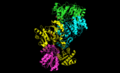 Succinyl Coenzyme A Synthetase heterotetramer with ligands


