Tentaculites: Difference between revisions
CSV import |
CSV import Tags: mobile edit mobile web edit |
||
| Line 23: | Line 23: | ||
[[Category:Marine animals]] | [[Category:Marine animals]] | ||
{{Paleontology-stub}} | {{Paleontology-stub}} | ||
<gallery> | |||
File:TentaculitidDevonian.jpg|Tentaculites fossil from the Devonian period | |||
File:Tentaculites_bellulus.jpg|Tentaculites bellulus specimen | |||
File:Tentaculites_2.jpg|Tentaculites fossil | |||
File:Tentaculitid041011.jpg|Tentaculites fossil | |||
</gallery> | |||
Latest revision as of 04:36, 18 February 2025
Tentaculites is an extinct genus of marine animals that lived from the Ordovician to the Devonian period, approximately 470 to 358 million years ago. These organisms are known for their distinctive, conical shells, which are characterized by numerous small, tentacle-like structures. The exact nature of Tentaculites has been the subject of much debate among paleontologists, with theories suggesting they could be related to mollusks, annelids, or even a separate phylum entirely.
Morphology[edit]
Tentaculites shells are elongated, conical, and composed of calcite. They range in size from a few millimeters to several centimeters in length. The surface of the shell is marked by transverse rings or annulations, and in some species, longitudinal striations are present. The aperture of the shell is circular, and the interior houses what is presumed to be the living quarters of the animal. The presence of tentacle-like structures suggests that Tentaculites might have been a filter feeder, using these appendages to capture plankton and other small particles from the water.
Classification[edit]
The classification of Tentaculites has been controversial. Initially, they were thought to be related to cephalopods, a class of mollusks, due to their conical shells. However, the lack of a clear siphuncle (a tube-like structure found in cephalopods) and other molluscan features has led to doubts about this classification. Some researchers have proposed that Tentaculites belong to their own phylum, Tentaculita, which would include other similar extinct organisms. Others have suggested affinities with annelids (segmented worms) based on the presumed soft-body morphology inferred from the fossil record.
Habitat[edit]
Tentaculites inhabited marine environments across the globe, from shallow coastal waters to deeper oceanic settings. Their widespread distribution and abundance in certain rock layers make them useful as index fossils for dating and correlating the age of sedimentary rocks.
Fossil Record[edit]
Fossils of Tentaculites are found in sedimentary rocks from the Ordovician to the Devonian period. They are particularly abundant in Silurian-aged rocks, where they are often found in association with other marine fossils, indicating a diverse and vibrant marine ecosystem. The preservation of Tentaculites shells allows scientists to study the morphology and potentially the ecology of these enigmatic creatures.
Extinction[edit]
The reasons behind the extinction of Tentaculites at the end of the Devonian period are not entirely clear. It is likely that changes in marine environments, such as fluctuations in sea levels, temperature, and chemistry, played a role in their decline. The Devonian period is known for several significant extinction events that affected a wide range of marine life.
Conclusion[edit]
Tentaculites remain one of the more mysterious fossils from the Paleozoic era. Their unique morphology and uncertain taxonomic placement continue to intrigue and challenge paleontologists. Ongoing research and new fossil discoveries may eventually shed more light on the nature of these ancient marine animals.

This article is a paleontology stub. You can help WikiMD by expanding it!
-
 Tentaculites fossil from the Devonian period
 -
 Tentaculites bellulus specimen
 -
 Tentaculites fossil
 -
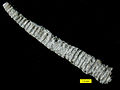 Tentaculites fossil


