Vestigial twin: Difference between revisions
No edit summary |
CSV import |
||
| Line 14: | Line 14: | ||
{{stb}} | {{stb}} | ||
{{stb}} | {{stb}} | ||
==Vestigial twin== | |||
<gallery> | |||
File:JohannSchenk-Twins.jpg|Historical depiction of conjoined twins by Johann Schenk | |||
File:Young_Indian_boy_with_parasitic_headless_attachment._Photogr_Wellcome_V0029567_(cropped).jpg|Young Indian boy with parasitic headless attachment | |||
File:13256_2016_1023_Fig2_HTML.jpg|Vestigial twin | |||
File:MRI-Philips.JPG|MRI scan showing vestigial twin | |||
</gallery> | |||
Latest revision as of 04:35, 18 February 2025
A vestigial twin is a form of parasitic twinning,<ref>Roger E.,
 Human Malformations and Related Anomalies. online version,

 Oxford University Press,


 ISBN 9780199386031,</ref> where the parasitic "twin" is so malformed and incomplete that it typically consists entirely of extra limbs or organs. It also can be a complete living being trapped inside the host person.
This phenomenon occurs when a fertilized ovum or partially formed embryo splits incompletely. The result can be anything from two whole people joined by a bit of skin (conjoined / Siamese twins), to one person with extra body parts belonging to the vestigial twin.
Most vestigial limbs are non-functional, and although they may have bones, muscles and nerve endings, they are not under the control of the host. The possession of six or more digits on the hands and feet (polydactyly) usually has a genetic or chromosomal cause, and is not a case of vestigial twinning.
References[edit]
<references group="" responsive="1"></references>
| This article is a stub. You can help WikiMD by registering to expand it. |
| This article is a stub. You can help WikiMD by registering to expand it. |
Vestigial twin[edit]
-
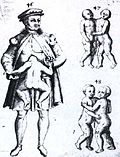 Historical depiction of conjoined twins by Johann Schenk
 -
 Young Indian boy with parasitic headless attachment
 -
 Vestigial twin
 -
 MRI scan showing vestigial twin

.jpg)


