Disease ecology: Difference between revisions
CSV import Tags: mobile edit mobile web edit |
CSV import |
||
| Line 29: | Line 29: | ||
{{medicine-stub}} | {{medicine-stub}} | ||
<gallery> | |||
File:Toronto_urban_sprawl.jpg|Urban sprawl in Toronto | |||
File:Pronghorns_Crossing_Highway_on_Seedskadee_NWR._(23769232906).jpg|Pronghorns crossing highway | |||
File:Ixodes_ricinus_ticks.jpg|Ixodes ricinus ticks | |||
File:Flickr_-_Rainbirder_-_Barn_Owl_(Tyto_alba).jpg|Barn Owl (Tyto alba) | |||
</gallery> | |||
Latest revision as of 04:35, 18 February 2025
Disease Ecology is an interdisciplinary field that examines the interactions between the biology of infectious diseases and the ecological and evolutionary dynamics of host populations. It is a branch of ecology that focuses on understanding how biological and environmental factors influence the transmission, spread, and evolution of pathogens. Disease ecology integrates principles from epidemiology, evolutionary biology, conservation biology, and population dynamics to explore the complex relationships between hosts, pathogens, and their environment.
Overview[edit]
Disease ecology seeks to understand the patterns and drivers of disease distribution and abundance in natural populations. It involves studying how environmental factors such as climate change, habitat destruction, and biodiversity loss affect disease dynamics. Additionally, it examines how diseases can influence the structure and function of ecosystems. This field is critical for predicting disease outbreaks, managing wildlife diseases, and understanding the impacts of emerging infectious diseases on human, wildlife, and plant health.
Key Concepts[edit]
- Host-Pathogen Interactions: The complex interactions between a host and a pathogen, including how pathogens invade hosts, evade immune responses, and how hosts defend against infections.
- Transmission Dynamics: The mechanisms and factors that influence how diseases are transmitted between individuals and across populations.
- Disease Reservoirs: Populations or environments where a pathogen can be permanently maintained and from which infection is transmitted to a defined target population.
- Vector-borne Diseases: Diseases that are transmitted to humans or other animals by insects or other arthropods. Examples include malaria, dengue fever, and Lyme disease.
- Zoonotic Diseases: Diseases that are transmitted from animals to humans. Understanding the ecology of these diseases is crucial for predicting and preventing outbreaks.
Research Methods[edit]
Disease ecology employs a variety of research methods, including field studies, laboratory experiments, and mathematical modeling. Field studies may involve monitoring disease outbreaks in natural populations, while laboratory experiments can explore the mechanisms of disease transmission and host-pathogen interactions. Mathematical models are used to predict disease spread and to evaluate the potential impacts of control strategies.
Applications[edit]
The insights gained from disease ecology research have important applications in public health, wildlife management, and conservation. For example, understanding the ecological drivers of zoonotic disease emergence can inform strategies to prevent future pandemics. Similarly, insights into the role of biodiversity in disease regulation can guide conservation efforts and land-use planning to reduce disease risks.
Challenges[edit]
One of the major challenges in disease ecology is the complexity of ecological systems and the multitude of factors that can influence disease dynamics. Climate change, human activities, and the movement of people and goods around the globe can all alter disease patterns in unpredictable ways. Additionally, the emergence of new pathogens and the evolution of antibiotic resistance require constant vigilance and adaptation of disease management strategies.
Conclusion[edit]
Disease ecology is a vital field that contributes to our understanding of how diseases spread and evolve within and between species. By integrating knowledge from multiple disciplines, disease ecologists can develop strategies to predict, prevent, and control diseases, ultimately protecting human health, biodiversity, and ecosystem services.

-
 Urban sprawl in Toronto
 -
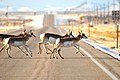 Pronghorns crossing highway
 -
 Ixodes ricinus ticks
 -
 Barn Owl (Tyto alba)

.jpg)

.jpg)
