Vaginal epithelium: Difference between revisions
CSV import |
CSV import Tags: mobile edit mobile web edit |
||
| Line 43: | Line 43: | ||
[[Category:Female reproductive system]] | [[Category:Female reproductive system]] | ||
<gallery> | |||
File:Gartner_Duct_Cyst_(low_power)_(4881813679).jpg|Gartner Duct Cyst (low power) | |||
File:Vagina_(mucosa).JPG|Vagina mucosa | |||
File:Glycogen_structure.svg|Glycogen structure | |||
File:Chlamydia_pneumoniae.jpg|Chlamydia pneumoniae | |||
File:VaginaHisto.jpg|Vaginal epithelium | |||
</gallery> | |||
Latest revision as of 04:35, 18 February 2025
Vaginal Epithelium[edit]
The vaginal epithelium is the innermost layer of the vaginal wall, consisting of stratified squamous epithelial cells. This layer plays a crucial role in protecting the underlying tissues and maintaining the health of the vaginal environment.
_(4881813679).jpg)
Structure[edit]
The vaginal epithelium is composed of multiple layers of cells that provide a barrier against pathogens and physical abrasion. The surface layer consists of flattened, keratinized cells, while the deeper layers contain more cuboidal and columnar cells. This stratification is essential for the protective function of the epithelium.
.JPG)
Function[edit]
The primary function of the vaginal epithelium is to protect the vaginal tissues from mechanical damage and infection. It also plays a role in maintaining the vaginal pH and microflora, which are crucial for preventing infections.
Glycogen and Microflora[edit]
The epithelial cells contain glycogen, which is metabolized by lactobacilli to produce lactic acid. This process helps maintain an acidic environment in the vagina, inhibiting the growth of pathogenic bacteria.

Clinical Significance[edit]
Changes in the vaginal epithelium can be indicative of various medical conditions. For example, thinning of the epithelium is associated with vaginal atrophy, often seen in postmenopausal women. Infections such as Chlamydia trachomatis can also affect the epithelial layer.

Histology[edit]
Histological examination of the vaginal epithelium reveals its stratified squamous nature. The presence of glycogen-rich cells is a characteristic feature, which can be observed under a microscope.

Related Pages[edit]
<references group="" responsive="1"></references>
-
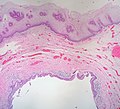 Gartner Duct Cyst (low power)
 -
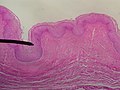 Vagina mucosa
 -
 Glycogen structure
 -
 Chlamydia pneumoniae
 -
 Vaginal epithelium
