Tell Abu Hureyra: Difference between revisions
CSV import Tags: mobile edit mobile web edit |
CSV import Tags: mobile edit mobile web edit |
||
| Line 28: | Line 28: | ||
{{Archaeology-stub}} | {{Archaeology-stub}} | ||
{{food-stub}} | {{food-stub}} | ||
<gallery> | |||
File:Abu_Hureyra_meltglass.png|Melt glass from Tell Abu Hureyra | |||
File:NatufianSpread.svg|Spread of the Natufian culture | |||
File:Fertile_crescent_Neolithic_B_circa_7500_BC.jpg|Fertile Crescent during Neolithic B, circa 7500 BC | |||
File:Calibrated_Carbon_14_dates_for_Abu_Hureyra_as_of_2013.jpg|Calibrated Carbon 14 dates for Abu Hureyra as of 2013 | |||
File:Abu_Hureyra_-_grinding_stone.jpg|Grinding stone from Tell Abu Hureyra | |||
</gallery> | |||
Latest revision as of 04:34, 18 February 2025
Tell Abu Hureyra is an archaeological site located in the Euphrates valley in modern-day Syria. The site is significant for its substantial evidence of a transition from foraging to farming in the ancient Near East.
History[edit]
Tell Abu Hureyra was first excavated in 1972 by a team of archaeologists from the University of Edinburgh. The site was occupied in two main phases: Abu Hureyra 1, which was occupied by a community of hunter-gatherers between 13,500 and 11,500 years ago, and Abu Hureyra 2, which was occupied by a farming community from 11,500 to 7,000 years ago.
Abu Hureyra 1[edit]
During the Abu Hureyra 1 phase, the inhabitants of the site were primarily hunter-gatherers. They hunted gazelle and other game, and gathered wild cereals. The archaeological evidence from this phase includes numerous stone tools, animal bones, and plant remains.
Abu Hureyra 2[edit]
The Abu Hureyra 2 phase saw a transition to agriculture. The inhabitants of the site began to cultivate cereals and legumes, and to keep sheep and goats. The archaeological evidence from this phase includes the remains of mud-brick houses, pottery, and stone tools associated with farming.
Significance[edit]
The significance of Tell Abu Hureyra lies in its evidence for the transition from foraging to farming. The site provides a unique insight into the process of Neolithic Revolution, one of the most significant events in human history.
See also[edit]


-
 Melt glass from Tell Abu Hureyra
 -
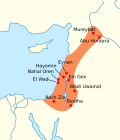 Spread of the Natufian culture
 -
 Fertile Crescent during Neolithic B, circa 7500 BC
 -
 Calibrated Carbon 14 dates for Abu Hureyra as of 2013
 -
 Grinding stone from Tell Abu Hureyra


