Environmental remediation: Difference between revisions
CSV import |
CSV import Tags: mobile edit mobile web edit |
||
| Line 32: | Line 32: | ||
{{Environmental-stub}} | {{Environmental-stub}} | ||
<gallery> | |||
File:August_2012,_Up_close_to_a_dredge_New_Bedford_Harbor,_MA_(7997417199).jpg|Dredging operations in New Bedford Harbor, MA | |||
File:Environmental_Remediation_Progress_at_the_Danang_Airport_site_(8966658935).jpg|Remediation progress at Danang Airport site | |||
File:RhodesRemediationUnionCarbideHomebushBay.JPG|Remediation at Union Carbide site, Homebush Bay | |||
</gallery> | |||
Latest revision as of 04:34, 18 February 2025
Environmental remediation is the process of removing pollution or contaminants from environmental media such as soil, groundwater, sediment, or surface water for the general protection of human health and the environment. This scientific field is critical for restoring ecosystems that have been contaminated by hazardous materials and ensuring that they can once again support life. Environmental remediation is a complex, interdisciplinary field that involves a variety of strategies, technologies, and regulatory requirements.
Overview[edit]
Environmental remediation deals with the removal of pollution or contaminants from environmental media such as soil, groundwater, sediment, or surface water. When a site is found to be contaminated, a detailed assessment is conducted to understand the extent of contamination and the potential risk to public health or the environment. Based on this assessment, a remediation strategy is formulated and implemented to clean up the contaminated site to meet regulatory standards or make the site safe for future use.
Types of Remediation Technologies[edit]
There are several technologies used in environmental remediation, each suited to specific types of contaminants and environmental conditions. These technologies can be broadly classified into two categories: ex-situ and in-situ.
Ex-situ Remediation[edit]
Ex-situ remediation involves the removal of contaminated material from the site for treatment elsewhere. Common ex-situ techniques include:
- Soil excavation: The physical removal of contaminated soil to be treated or disposed of off-site.
- Pump and treat: The extraction of contaminated groundwater for treatment at the surface.
In-situ Remediation[edit]
In-situ remediation treats contamination without removing the contaminated material from its original location. Popular in-situ techniques include:
- Bioremediation: The use of microorganisms to degrade organic contaminants.
- Phytoremediation: The use of plants to absorb or break down pollutants.
- Chemical oxidation: The use of chemical agents to transform contaminants into less harmful substances.
Regulatory Framework[edit]
The regulatory framework for environmental remediation varies by country but generally involves a series of steps including site assessment, remediation plan approval, implementation of the plan, and site monitoring post-remediation. In the United States, the Comprehensive Environmental Response, Compensation, and Liability Act (CERCLA), commonly known as Superfund, governs the remediation of contaminated sites.
Challenges and Considerations[edit]
Environmental remediation faces several challenges, including technological limitations, the high cost of remediation projects, and the difficulty of completely removing certain types of contaminants. Additionally, remediation projects must balance the need for cleanup with the potential impact on the local community and the environment.
Future Directions[edit]
Advancements in technology and a better understanding of biological processes are leading to more effective and less intrusive remediation techniques. Emerging trends include the use of nanotechnology for contaminant removal and the development of more sustainable remediation methods that minimize environmental impact.
This environment-related article is a stub. You can help WikiMD by expanding it.
-
 Dredging operations in New Bedford Harbor, MA
 -
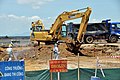 Remediation progress at Danang Airport site
 -
 Remediation at Union Carbide site, Homebush Bay
.jpg)
.jpg)

