Zopiclone: Difference between revisions
CSV import |
CSV import |
||
| Line 32: | Line 32: | ||
{{Pharmacology-stub}} | {{Pharmacology-stub}} | ||
{{medicine-stub}} | {{medicine-stub}} | ||
<gallery> | |||
File:Zopiclone_structure.svg|Chemical structure of Zopiclone | |||
File:Zopiclone-from-xtal-Mercury-3D-bs.png|3D model of Zopiclone | |||
File:Zopiclone_7.5mg.jpg|Zopiclone 7.5 mg tablets | |||
File:Zopiclone_metabolism.svg|Metabolism pathway of Zopiclone | |||
</gallery> | |||
Latest revision as of 04:32, 18 February 2025
Zopiclone is a nonbenzodiazepine hypnotic agent used in the treatment of insomnia. It is a cyclopyrrolone, which increases the normal transmission of the neurotransmitter gamma-aminobutyric acid (GABA) in the central nervous system, as benzodiazepines do, but in a different way. Zopiclone is known to bind to the GABA receptor complex and modulates the opening of the chloride ion channel. The increased GABAergic transmission provides hypnotic (sleep-inducing), anxiolytic (anti-anxiety), anticonvulsant, and muscle relaxant properties.
Medical Uses[edit]
Zopiclone is primarily prescribed for the short-term management of insomnia. It helps decrease the time to sleep onset and increases the duration of sleep but is not recommended for long-term use due to the risk of dependence, tolerance, and withdrawal symptoms.
Adverse Effects[edit]
Common side effects of zopiclone include drowsiness, dizziness, and dry mouth. Less frequent side effects may include headache, nausea, and altered taste sensation. Long-term use can lead to dependence, tolerance, and withdrawal symptoms upon cessation. There is also a risk of amnesia and impaired psychomotor function, which may affect the ability to drive or operate machinery.
Pharmacology[edit]
Zopiclone acts by binding to the GABAA receptor complex and modulating the chloride ion channel. This action enhances the inhibitory effect of GABA on neuronal excitability, resulting in sedative and hypnotic effects. Zopiclone has a rapid onset of action and a half-life of approximately 5 to 6 hours.
Interactions[edit]
Zopiclone's sedative effects can be enhanced when taken with other central nervous system depressants such as alcohol, opioids, and other sedatives. The use of zopiclone with these substances can increase the risk of respiratory depression, coma, and death. Caution is advised when combining zopiclone with other medications that affect the central nervous system.
Dependence and Withdrawal[edit]
Dependence on zopiclone can develop with prolonged use. Withdrawal symptoms, including insomnia, anxiety, tremor, and agitation, may occur after abrupt discontinuation or dose reduction. Gradual tapering of the dose is recommended to minimize withdrawal symptoms.
Legal Status[edit]
The legal status of zopiclone varies by country. It is typically classified as a controlled substance due to its potential for abuse and dependence.
See Also[edit]


-
 Chemical structure of Zopiclone
 -
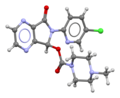 3D model of Zopiclone
 -
 Zopiclone 7.5 mg tablets
 -
 Metabolism pathway of Zopiclone


