Solanum pseudocapsicum: Difference between revisions
CSV import Tags: mobile edit mobile web edit |
CSV import |
||
| Line 25: | Line 25: | ||
[[Category:Poisonous plants]] | [[Category:Poisonous plants]] | ||
{{Solanaceae-stub}} | {{Solanaceae-stub}} | ||
<gallery> | |||
File:Solanum_pseudocapsicum04.jpg|Solanum pseudocapsicum plant with berries | |||
File:Solanum_pseudocapsicum_MHNT.BOT.2011.3.92.jpg|Solanum pseudocapsicum herbarium specimen | |||
File:Solanum_pseudocapsicum3.jpg|Close-up of Solanum pseudocapsicum berries | |||
File:Acı_biber.JPG|Solanum pseudocapsicum | |||
</gallery> | |||
Latest revision as of 04:31, 18 February 2025
Solanum pseudocapsicum is a species of the Solanum genus, which is part of the larger Solanaceae family. Commonly known as the Jerusalem Cherry, Winter Cherry, or Christmas Cherry, it is a perennial plant native to South America but has been introduced to various other regions worldwide.
Description[edit]
Solanum pseudocapsicum is a small shrub that typically grows to a height of 1-2 meters. It has simple, ovate leaves with entire margins, and the plant produces small, star-shaped white flowers. The most distinctive feature of the plant is its bright red, cherry-like fruits. Despite their attractive appearance, these fruits are toxic if ingested.
Distribution and Habitat[edit]
Originally native to South America, Solanum pseudocapsicum has been introduced to many other parts of the world, including North America, Europe, and Asia. It is typically found in disturbed habitats and is often grown as an ornamental plant due to its attractive fruit.
Cultivation[edit]
Solanum pseudocapsicum is often grown as a houseplant, particularly during the winter months due to its bright, cherry-like fruits. It prefers well-drained soil and a sunny location, but can tolerate a range of conditions. The plant is propagated by seed.
Toxicity[edit]
Despite its common name, the Jerusalem Cherry is not a true cherry and its fruits are toxic if ingested. They contain solanine, a toxic alkaloid that can cause symptoms such as nausea, vomiting, and diarrhea if ingested.
See Also[edit]
References[edit]
<references />
 This Solanaceae related article is a stub. You can help WikiMD by expanding it.
-
 Solanum pseudocapsicum plant with berries
 -
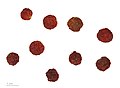 Solanum pseudocapsicum herbarium specimen
 -
 Close-up of Solanum pseudocapsicum berries
 -
 Solanum pseudocapsicum


