Proso millet: Difference between revisions
CSV import Tags: mobile edit mobile web edit |
CSV import |
||
| Line 29: | Line 29: | ||
[[Category:Sustainable agriculture]] | [[Category:Sustainable agriculture]] | ||
{{Agriculture-stub}} | {{Agriculture-stub}} | ||
<gallery> | |||
File:Mature_Proso_Millet_Panicles.jpg|Mature Proso Millet Panicles | |||
File:Panicum_miliaceum_MHNT.BOT.2015.34.20.jpg|Panicum miliaceum specimen | |||
File:Centres_of_origin_and_spread_of_agriculture.svg|Centres of origin and spread of agriculture | |||
File:White_Proso_Millet.jpg|White Proso Millet | |||
File:Gijang-bap.jpg|Gijang-bap | |||
</gallery> | |||
Latest revision as of 04:25, 18 February 2025
Proso Millet (Panicum miliaceum) is a highly nutritious cereal grain that belongs to the grass family Poaceae. It is known for its adaptability to various environmental conditions, making it a significant crop in many parts of the world, particularly in Asia, Europe, and North America. Proso millet is recognized for its short growing season and ability to thrive in arid conditions where many other crops would fail, thus playing a crucial role in food security and sustainable agriculture.
Description[edit]
Proso millet is an annual plant that can grow up to 1 meter in height. Its stems are slender, and the leaves are broad and lanceolate. The plant produces small, round grains that can be white, yellow, red, or brown. These grains are encased in a hull that is typically removed before human consumption.
Cultivation[edit]
The cultivation of Proso millet does not require high levels of agricultural inputs such as fertilizers and pesticides, making it an environmentally friendly crop. It is sown in the late spring and harvested in late summer or early autumn, depending on the local climate. Proso millet has a growing season of approximately 60 to 90 days, which is considerably shorter than many other cereals, allowing it to be grown in regions with short growing seasons.
Nutritional Value[edit]
Proso millet is rich in essential nutrients, including vitamins (B vitamins, especially niacin, B6, and folic acid), minerals (magnesium, phosphorus, iron, calcium, zinc, and potassium), and dietary fibers. It is also a good source of protein and antioxidants. Proso millet is gluten-free, making it a suitable grain for individuals with gluten intolerance or celiac disease.
Uses[edit]
Proso millet can be used in various culinary applications. It can be cooked whole and used in salads, soups, and stews, or ground into flour and used for baking bread, cakes, and noodles. In addition to its use in human nutrition, Proso millet is also utilized as bird feed and fodder for livestock.
Health Benefits[edit]
The consumption of Proso millet has been associated with several health benefits, including improved digestive health, reduced risk of heart disease, and control of blood sugar levels. Its high fiber content can aid in digestion and prevent constipation, while its low glycemic index makes it beneficial for individuals with diabetes.
Environmental Impact[edit]
Proso millet has a positive environmental impact due to its low water and fertilizer requirements. It can be grown in poor soils and helps in preventing soil erosion. Its ability to grow under dry conditions makes it an important crop for sustaining agricultural productivity in the face of climate change.
Challenges[edit]
Despite its numerous benefits, Proso millet faces challenges in terms of global recognition and utilization. It is often considered a "minor" grain compared to staples like wheat, rice, and maize, leading to limited research and development efforts. Additionally, there is a lack of awareness about its nutritional and environmental benefits, which hampers its adoption in diets and farming systems worldwide.
Conclusion[edit]
Proso millet is a versatile and nutritious grain that offers significant health and environmental benefits. Its cultivation can contribute to sustainable agriculture and food security, especially in regions prone to drought and poor soil conditions. Increased awareness and research into Proso millet could enhance its utilization and integration into global food systems.
This article is a agriculture stub. You can help WikiMD by expanding it!
-
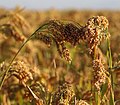 Mature Proso Millet Panicles
 -
 Panicum miliaceum specimen
 -
 Centres of origin and spread of agriculture
 -
White Proso Millet
-
Gijang-bap


