Lateral corticospinal tract: Difference between revisions
CSV import Tags: mobile edit mobile web edit |
CSV import |
||
| Line 33: | Line 33: | ||
[[Category:Motor System]] | [[Category:Motor System]] | ||
[[Category:Central Nervous System]] | [[Category:Central Nervous System]] | ||
<gallery> | |||
File:Gray680.png|Lateral corticospinal tract | |||
File:Gray687.png|Lateral corticospinal tract | |||
File:Gray688.png|Lateral corticospinal tract | |||
File:Gray764.png|Lateral corticospinal tract | |||
</gallery> | |||
Latest revision as of 04:21, 18 February 2025
Lateral Corticospinal Tract[edit]
The Lateral Corticospinal Tract is a major descending pathway in the central nervous system that plays a crucial role in the voluntary control of movement. It is responsible for transmitting signals from the motor cortex to the spinal cord, where it synapses with lower motor neurons that innervate muscles throughout the body.
Anatomy[edit]
The Lateral Corticospinal Tract originates from the primary motor cortex, located in the precentral gyrus of the frontal lobe. The axons of the upper motor neurons in this region descend through the internal capsule, cerebral peduncle, and pons, before crossing over to the contralateral side of the brainstem at the level of the medulla. This crossing is known as the decussation of the pyramids.
After crossing over, the axons continue their descent in the lateral funiculus of the spinal cord, giving rise to the name "Lateral Corticospinal Tract." The tract terminates in the ventral horn of the spinal cord, where it synapses with lower motor neurons. These lower motor neurons then project to the muscles, enabling voluntary movement.
Function[edit]
The Lateral Corticospinal Tract is primarily involved in the control of skilled and fine movements. It allows for precise control of individual muscles or groups of muscles, facilitating activities such as writing, playing musical instruments, and manipulating objects.
The upper motor neurons in the Lateral Corticospinal Tract receive input from various regions of the brain, including the sensory cortex, basal ganglia, and cerebellum. This input helps to modulate and refine the motor commands sent to the spinal cord, ensuring smooth and coordinated movement.
Clinical Significance[edit]
Damage to the Lateral Corticospinal Tract can result in significant motor deficits. Conditions such as stroke, spinal cord injury, and certain neurodegenerative diseases can disrupt the integrity of this pathway, leading to weakness, spasticity, and loss of fine motor control.
See Also[edit]
References[edit]
<references />
-
 Lateral corticospinal tract
 -
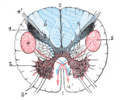 Lateral corticospinal tract
 -
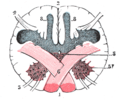 Lateral corticospinal tract
 -
 Lateral corticospinal tract


