Bog butter: Difference between revisions
CSV import Tags: mobile edit mobile web edit |
CSV import |
||
| Line 27: | Line 27: | ||
[[Category:Archaeological artifacts]] | [[Category:Archaeological artifacts]] | ||
{{food-stub}} | {{food-stub}} | ||
<gallery> | |||
File:Bog_butter.JPG|Bog butter | |||
File:Bog_butter_from_A_Descriptive_Catalogue_of_the_Antiquities_in_the_Museum_of_the_Royal_Irish_Academy_1857.png|Bog butter from "A Descriptive Catalogue of the Antiquities in the Museum of the Royal Irish Academy" 1857 | |||
File:Bog_butter_-_Ulster_Museum.JPG|Bog butter - Ulster Museum | |||
</gallery> | |||
Latest revision as of 04:19, 18 February 2025
Bog butter refers to an ancient form of butter that has been buried and preserved in peat bogs, particularly in Ireland and Great Britain. The practice of burying bog butter dates back at least to the Iron Age, and may have been used to preserve the butter or as an offering to the gods.
History[edit]
The earliest known examples of bog butter date to the Iron Age, but the practice continued into the 19th century. The butter was often placed in wooden containers or wrapped in animal skins before being buried in the bog. The cool, low-oxygen environment of the bog would help to preserve the butter.
Preservation[edit]
The preservation process for bog butter involves burying the butter in the peat bogs for an extended period of time. The low temperature, low oxygen, and highly acidic environment of the bogs make them ideal for preservation. The butter undergoes a form of anaerobic fermentation, which gives it a distinctive flavor.
Discovery[edit]
Bog butter is often discovered during peat cutting. When found, it can range in size from the size of a fist to large lumps weighing several kilograms. Some have been found in wooden containers or wrapped in a cloth. The National Museum of Ireland and the British Museum have several examples of bog butter in their collections.
See also[edit]
References[edit]
<references />
External links[edit]

-
 Bog butter
 -
 Bog butter from "A Descriptive Catalogue of the Antiquities in the Museum of the Royal Irish Academy" 1857
 -
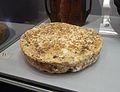 Bog butter - Ulster Museum


