Agouti-signaling protein: Difference between revisions
CSV import |
CSV import |
||
| Line 40: | Line 40: | ||
[[Category:Genetics]] | [[Category:Genetics]] | ||
[[Category:Obesity]] | [[Category:Obesity]] | ||
== Agouti-signaling_protein == | |||
<gallery> | |||
File:1y7k.png|Agouti-signaling protein structure | |||
File:Proposed_mechanism_for_the_relationship_between_ectopic_agouti_expression_and_the_development_of_‘yellow_obese_mouse_syndrome’.jpg|Proposed mechanism for the relationship between ectopic agouti expression and the development of ‘yellow obese mouse syndrome’ | |||
File:Agouti_Mice.jpg|Agouti mice | |||
</gallery> | |||
Latest revision as of 04:16, 18 February 2025
Agouti-signaling protein[edit]


The agouti-signaling protein (ASIP) is a protein that in humans is encoded by the ASIP gene. It is involved in the regulation of melanin production in mammals, affecting the pigmentation of the skin and hair.
Function[edit]
The primary function of the agouti-signaling protein is to act as an antagonist to the melanocortin 1 receptor (MC1R), which is a G protein-coupled receptor involved in the regulation of melanin synthesis. By binding to MC1R, ASIP inhibits the production of eumelanin, the dark pigment, and promotes the production of pheomelanin, the lighter pigment. This results in a lighter coat color in animals.
Genetic and Molecular Basis[edit]
The ASIP gene is located on chromosome 20 in humans. It is expressed in various tissues, including the skin, where it plays a crucial role in determining hair color. Mutations or variations in the ASIP gene can lead to changes in pigmentation and have been associated with certain phenotypes such as the yellow coat color in mice.
Role in Obesity[edit]
In addition to its role in pigmentation, the agouti-signaling protein has been implicated in the regulation of energy homeostasis and obesity. In mice, ectopic expression of the agouti protein can lead to the development of the "yellow obese mouse syndrome," characterized by yellow fur, obesity, and insulin resistance. This is due to the agouti protein's ability to antagonize other melanocortin receptors involved in energy balance.
Clinical Significance[edit]
Understanding the function of the agouti-signaling protein and its interactions with melanocortin receptors has implications for the study of human diseases such as obesity and diabetes. Research into the modulation of ASIP activity could potentially lead to therapeutic strategies for these conditions.
Related pages[edit]
Gallery[edit]
-
 Structure of the agouti-signaling protein
 -
 Proposed mechanism for the relationship between ectopic agouti expression and the development of ‘yellow obese mouse syndrome’.
 -
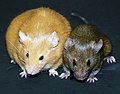 Agouti mice showing different coat colors.
Agouti-signaling_protein[edit]
-
Agouti-signaling protein structure
-
Proposed mechanism for the relationship between ectopic agouti expression and the development of ‘yellow obese mouse syndrome’
-
Agouti mice
