Corey–Winter olefin synthesis: Difference between revisions
CSV import |
CSV import |
||
| Line 29: | Line 29: | ||
[[Category:Name reactions]] | [[Category:Name reactions]] | ||
{{Chemistry-stub}} | {{Chemistry-stub}} | ||
<gallery> | |||
File:Corey-Winter_olefination_overview.svg|Corey–Winter olefin synthesis overview | |||
File:Corey-Winter_olefination_mechanism_v1.svg|Corey–Winter olefin synthesis mechanism version 1 | |||
File:CoreyWinterMech.svg|Corey–Winter olefin synthesis mechanism | |||
</gallery> | |||
Latest revision as of 04:16, 18 February 2025
Corey–Winter Olefin Synthesis is a series of chemical reactions designed for the preparation of alkenes (olefins) from 1,2-diols (vicinal diols). The process involves the conversion of diols into cyclic sulfates followed by their elimination under reductive conditions to yield alkenes. This method is named after its inventors, Elias James Corey and Roland A. Winter, who first reported the synthesis in 1963.
Overview[edit]
The Corey–Winter olefin synthesis is particularly valuable in organic chemistry for its ability to generate alkenes from more readily available diols. The reaction proceeds through the formation of a cyclic sulfate intermediate, which upon reduction, typically with a phosphorus(III) compound such as triethyl phosphite, leads to the formation of an alkene and a by-product of sulfur dioxide (SO2).
Reaction Mechanism[edit]
The mechanism of the Corey–Winter olefin synthesis can be divided into two main steps:
- Formation of the cyclic sulfate: The vicinal diol is first treated with a sulfuryl chloride (SO2Cl2) in the presence of a base, such as pyridine, to form a cyclic sulfate.
- Reductive elimination: The cyclic sulfate is then subjected to reductive conditions, often using a phosphorus(III) reagent like triethyl phosphite, which leads to the elimination of sulfur dioxide and the formation of the desired alkene.
Applications[edit]
The Corey–Winter olefin synthesis is used in organic synthesis for the preparation of alkenes from diols. It is particularly useful when the diol is not easily accessible to other dehydration methods, such as those requiring strong acidic conditions which might affect sensitive functional groups in the molecule.
Advantages and Limitations[edit]
One of the main advantages of the Corey–Winter synthesis is its mild reaction conditions, which are compatible with a wide range of functional groups. However, the method does have limitations, including the need for specific reagents like sulfuryl chloride and triethyl phosphite, and the generation of sulfur dioxide as a by-product, which requires appropriate handling and disposal.
See Also[edit]
References[edit]
<references/>

-
 Corey–Winter olefin synthesis overview
 -
 Corey–Winter olefin synthesis mechanism version 1
 -
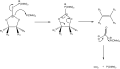 Corey–Winter olefin synthesis mechanism


