Cover crop: Difference between revisions
CSV import |
CSV import |
||
| Line 33: | Line 33: | ||
{{Agriculture-stub}} | {{Agriculture-stub}} | ||
<gallery> | |||
File:A_cover_crop_of_Tillage_Radish_in_early_November.jpg|A cover crop of Tillage Radish in early November | |||
File:Northwestern_South_Dakota_cover_crops,_2015_(20097473376).jpg|Northwestern South Dakota cover crops, 2015 | |||
File:Hairy_vetch_cover_crop.jpg|Hairy vetch cover crop | |||
</gallery> | |||
Latest revision as of 04:15, 18 February 2025
Cover crops are plants grown primarily to improve and protect the soil during periods when main crops are not cultivated. They play a crucial role in sustainable agriculture by enhancing soil health, reducing erosion, improving water infiltration, and managing pests and weeds. Cover crops can include a variety of grasses, legumes, and other green plants used in rotation with regular crops.
Benefits of Cover Crops[edit]
Cover crops offer numerous benefits to the soil and the environment, including:
- Soil Erosion Control: By providing ground cover, they reduce the impact of rain and wind on the soil, thus preventing erosion.
- Soil Health Improvement: They add organic matter to the soil, improving its structure, nutrient content, and overall health.
- Weed Suppression: The dense growth of cover crops can outcompete weeds, reducing the need for herbicides.
- Pest Management: Certain cover crops can suppress soil-borne pests and diseases or provide habitat for beneficial insects.
- Water Management: They help in water infiltration and moisture retention in the soil, reducing the need for irrigation.
- Nitrogen Fixation: Leguminous cover crops can fix atmospheric nitrogen into the soil, reducing the need for synthetic fertilizers.
Types of Cover Crops[edit]
Cover crops can be broadly classified into two categories based on their lifecycle: annuals and perennials. Furthermore, they can be categorized based on their family, such as legumes, grasses, and brassicas.
- Legumes: Such as clover, vetch, and peas, are valued for their ability to fix atmospheric nitrogen.
- Grasses: Including cereal rye, oats, and barley, are excellent for improving soil structure and organic matter.
- Brassicas: Like radishes and mustards, are known for their deep roots that can break up compacted soil.
Selection and Management[edit]
The selection of a cover crop depends on the specific goals, such as nitrogen fixation, erosion control, or weed suppression. It also depends on the climate, soil type, and the main crops grown in the rotation. Proper management of cover crops is crucial for maximizing their benefits. This includes timely planting and termination, choosing the right species mix, and integrating them into the crop rotation plan.
Challenges[edit]
While cover crops offer numerous benefits, there are also challenges in their adoption, including additional costs, labor, and the need for specialized knowledge in managing them effectively. Moreover, the termination of cover crops, especially in no-till systems, requires careful planning to avoid competition with the main crops.
Conclusion[edit]
Cover crops are a key component of sustainable agriculture, offering significant benefits to soil health, water management, and biodiversity. Despite the challenges, their integration into farming systems can lead to long-term environmental and economic benefits.

This article is a agriculture stub. You can help WikiMD by expanding it!
-
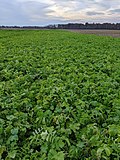 A cover crop of Tillage Radish in early November
 -
 Northwestern South Dakota cover crops, 2015
 -
Hairy vetch cover crop

.jpg)

