Camunian rose: Difference between revisions
CSV import |
CSV import |
||
| Line 28: | Line 28: | ||
{{Archaeology-stub}} | {{Archaeology-stub}} | ||
{{food-stub}} | {{food-stub}} | ||
<gallery> | |||
File:Rosa_camuna_R24_-_Foppe_-_Nadro_(Foto_Luca_Giarelli).jpg|Camunian rose | |||
File:Rosa_camuna_R2-3_-_Carpene_-_Sellero_(Foto_Luca_Giarelli).jpg|Camunian rose | |||
File:Rosa_camuna_svastika_vite57.jpg|Camunian rose | |||
</gallery> | |||
Latest revision as of 04:13, 18 February 2025
Camunian rose (rosa camuna in Italian) is a rock engraving symbol that is found in the Val Camonica, a valley in the central Alps, in the Lombardy region of northern Italy. The symbol is named after the Camuni people, who inhabited this area in the Iron Age and left behind a rich collection of rock art.
History[edit]
The Camunian rose was first identified and named by Italian archaeologist Emmanuel Anati in 1960. Anati, who conducted extensive research on the rock art of Val Camonica, noticed that this particular symbol appeared frequently in the engravings. He named it "Camunian rose" due to its resemblance to a stylized rose.
The Camunian rose is believed to date back to the Iron Age, specifically to the Camunni civilization that lived in Val Camonica from the 1st millennium BC. The Camunni were known for their rock art, which includes thousands of engravings depicting a variety of subjects, from animals and humans to symbols and geometric shapes.
Description[edit]
The Camunian rose is a complex symbol that consists of a central cup-mark, from which radiate several (usually nine) concentric circles or ellipses. From these circles, a varying number of "petals" or rays extend outward. The number of rays can range from four to nine, and they are often arranged in groups of two or three.
The meaning of the Camunian rose is not known. Some scholars believe it may have had a religious or cosmological significance, while others suggest it could have been a form of writing or a symbol of social status.
Legacy[edit]
Today, the Camunian rose is a recognized symbol of the Lombardy region and is used in the logo of the Lombardy Region and the Province of Brescia. It is also the emblem of the National Park of Rock Engravings in Capo di Ponte, Val Camonica.
See also[edit]
This article is a Italian history stub. You can help WikiMD by expanding it!


-
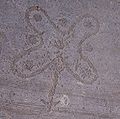 Camunian rose
 -
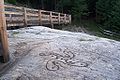 Camunian rose
 -
 Camunian rose
.jpg)
.jpg)

