Fruticose lichen: Difference between revisions
CSV import |
CSV import |
||
| Line 27: | Line 27: | ||
{{Lichen-stub}} | {{Lichen-stub}} | ||
== Fruticose_lichen == | |||
<gallery> | |||
File:Letharia_vulpina_JHollinger_crop.jpg|Letharia vulpina | |||
File:Fruticose_Lichen_(Teloschistes_chrysophtalmus)_(8558189274).jpg|Teloschistes chrysophtalmus | |||
File:Group_of_fruiticose_Lichen.jpg|Fruticose lichen | |||
</gallery> | |||
Latest revision as of 04:11, 18 February 2025
Fruticose lichen is a distinctive group of lichen species characterized by their unique growth form. Unlike other lichen types, fruticose lichens exhibit a three-dimensional, often shrub-like structure, which can be either erect or hanging. This form allows them to occupy ecological niches unavailable to other lichens, contributing significantly to biodiversity in various ecosystems.
Characteristics[edit]
Fruticose lichens are primarily identified by their branched, bushy appearance, which distinguishes them from the flat, leaf-like foliose lichens and the crusty crustose lichens. They possess a central cord or axis, around which the thallus, or body of the lichen, develops. This structure is often covered in a protective layer known as a cortex, which shields the lichen from environmental stressors. The color of fruticose lichens can vary widely, from bright greens and yellows to deep blues and purples, depending on their chemical composition and environmental factors.
Habitat[edit]
Fruticose lichens are found in a variety of habitats, ranging from arctic tundras to tropical rainforests. They are particularly prevalent in areas with clean air, as they are sensitive to air pollution. These lichens can grow on a variety of substrates, including soil, rocks, and the bark of trees, where they form symbiotic relationships with their host.
Ecological Role[edit]
The ecological role of fruticose lichens is multifaceted. They are important pioneers in some ecosystems, contributing to soil formation by breaking down rock surfaces and accumulating organic matter. Additionally, fruticose lichens serve as critical food sources for various animal species, including invertebrates and larger herbivores. They also provide nesting materials for birds and habitat for numerous microorganisms.
Reproduction[edit]
Fruticose lichens reproduce both sexually and asexually. Sexual reproduction occurs through the production of spores by the fungal partner, which must then come into contact with a compatible algal partner to form a new lichen. Asexual reproduction is more common and involves the dispersal of soredia or isidia, small clusters of algal cells surrounded by fungal hyphae, which can grow into new lichens upon finding a suitable substrate.
Conservation[edit]
Due to their sensitivity to environmental changes, fruticose lichens are often used as bioindicators to monitor the health of ecosystems, particularly air quality. However, this sensitivity also means that they are among the first organisms to suffer from environmental degradation, including air pollution, deforestation, and climate change. Conservation efforts are crucial to protect these unique organisms and the roles they play in their ecosystems.
See Also[edit]

Fruticose_lichen[edit]
-
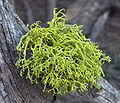 Letharia vulpina
 -
 Teloschistes chrysophtalmus
 -
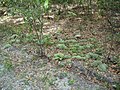 Fruticose lichen

_(8558189274).jpg)

