Pulse wave: Difference between revisions
CSV import Tags: mobile edit mobile web edit |
CSV import |
||
| Line 36: | Line 36: | ||
[[Category:Telecommunications]] | [[Category:Telecommunications]] | ||
[[Category:Seismology]] | [[Category:Seismology]] | ||
<gallery> | |||
File:PulseTrain.png|Pulse wave train | |||
File:PWM_duty_cycle_with_label.gif|PWM duty cycle with label | |||
File:Pulse_wave_33.33_percent_Fourier_series_50_harmonics.png|Pulse wave 33.33 percent Fourier series 50 harmonics | |||
</gallery> | |||
Latest revision as of 04:06, 18 February 2025
Pulse Wave[edit]
A pulse wave refers to a type of wave that carries energy through a medium by causing the particles of the medium to oscillate or vibrate. It is characterized by a series of periodic disturbances or pulses that propagate through the medium. Pulse waves can be found in various natural phenomena and are also utilized in different fields of science and technology.
Characteristics[edit]
Pulse waves exhibit several key characteristics that distinguish them from other types of waves. Firstly, they are characterized by a series of discrete pulses or disturbances that propagate through the medium. These pulses can be of different shapes and sizes, depending on the nature of the source that generated them.
Secondly, pulse waves are characterized by their periodicity. The pulses occur at regular intervals, with each pulse having a distinct amplitude, frequency, and wavelength. The amplitude represents the maximum displacement of the particles in the medium, while the frequency refers to the number of pulses occurring per unit time. The wavelength represents the distance between two consecutive pulses.
Lastly, pulse waves can travel through different types of media, including solids, liquids, and gases. The speed at which pulse waves propagate depends on the properties of the medium, such as its density, elasticity, and compressibility.
Applications[edit]
Pulse waves have various applications in different fields. In medicine, pulse waves are used to measure the heart rate and blood pressure of individuals. By analyzing the characteristics of the pulse wave, medical professionals can assess the health condition of a patient's cardiovascular system.
In telecommunications, pulse waves are utilized in pulse code modulation (PCM) systems. PCM is a method of digitally representing analog signals, such as voice or video, by sampling the signal at regular intervals and converting it into a series of binary pulses. These pulses can then be transmitted over long distances and reconstructed into the original analog signal at the receiving end.
In seismology, pulse waves are used to study earthquakes and the properties of the Earth's interior. Seismic waves generated by earthquakes propagate through the Earth, and by analyzing the characteristics of these waves, scientists can determine the location, magnitude, and depth of an earthquake.
See Also[edit]
References[edit]
<references />
-
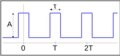 Pulse wave train
 -
 PWM duty cycle with label
 -
 Pulse wave 33.33 percent Fourier series 50 harmonics


