Acetes: Difference between revisions
CSV import |
CSV import |
||
| Line 42: | Line 42: | ||
[[Category:Marine biology]] | [[Category:Marine biology]] | ||
[[Category:Seafood]] | [[Category:Seafood]] | ||
== Acetes == | |||
<gallery> | |||
File:Alamang_shrimp_from_Banate_Bay,_sketch.gif|Alamang shrimp from Banate Bay, sketch | |||
File:Acetes_paraguayensis.png|Acetes paraguayensis | |||
File:3351Alamang_Acetes_sibogae_textures_24.jpg|Alamang Acetes sibogae textures | |||
</gallery> | |||
Latest revision as of 04:05, 18 February 2025
Acetes


Acetes is a genus of small shrimp-like crustaceans in the family Sergestidae. These organisms are commonly found in marine and estuarine environments and are known for their role in the food chain as both prey and predator. Acetes are often harvested for human consumption, particularly in Southeast Asia, where they are known as "alamang".
Description[edit]
Acetes are small, translucent crustaceans that typically measure between 1 and 4 centimeters in length. They possess a slender body with a distinct rostrum and long antennae. The exoskeleton is thin and flexible, allowing for rapid movement in the water. Acetes are characterized by their large eyes and numerous appendages, which aid in swimming and feeding.
Distribution and Habitat[edit]
Acetes species are widely distributed in tropical and subtropical regions around the world. They inhabit coastal waters, estuaries, and sometimes freshwater environments. These shrimp are often found in large swarms, which can be seen near the surface of the water, especially at night.
Ecology[edit]
Acetes play a significant role in the aquatic food web. They are filter feeders, consuming phytoplankton and zooplankton. In turn, they serve as an important food source for a variety of marine animals, including fish, birds, and marine mammals.
Human Use[edit]
In many parts of Asia, Acetes are harvested for food. They are often used to make shrimp paste, a common ingredient in Southeast Asian cuisine. The shrimp are typically caught using fine-meshed nets and are processed by drying or fermenting.
Species[edit]
There are several species within the genus Acetes, including:
- Acetes japonicus
- Acetes chinensis
- Acetes sibogae
- Acetes paraguayensis
Related pages[edit]
Gallery[edit]
-
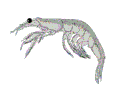 Sketch of Acetes from Banate Bay
 -
 Acetes paraguayensis
 -
 Acetes sibogae textures
Acetes[edit]
-
Alamang shrimp from Banate Bay, sketch
-
Acetes paraguayensis
-
Alamang Acetes sibogae textures
