Adverse childhood experiences: Difference between revisions
CSV import |
CSV import |
||
| Line 52: | Line 52: | ||
[[Category:Childhood trauma]] | [[Category:Childhood trauma]] | ||
[[Category:Public health]] | [[Category:Public health]] | ||
<gallery> | |||
File:List_of_generalized_ACEs.jpg|Adverse childhood experiences | |||
File:ACEs_Pyramid.png|Adverse childhood experiences | |||
File:ACEs_Study_State_Data_2009-2013.jpg|Adverse childhood experiences | |||
</gallery> | |||
Latest revision as of 04:04, 18 February 2025
Adverse Childhood Experiences[edit]
Adverse Childhood Experiences (ACEs) are potentially traumatic events that occur in childhood (0-17 years). These experiences can include various forms of abuse, neglect, and household dysfunction. The concept of ACEs was first introduced in the Adverse Childhood Experiences Study, which highlighted the long-term impacts of these experiences on health and well-being.
Types of ACEs[edit]
ACEs are typically categorized into three groups: abuse, neglect, and household challenges.
Abuse[edit]
- Physical abuse: Intentional use of physical force that can result in physical injury.
- Emotional abuse: Behaviors that harm a child's self-worth or emotional well-being.
- Sexual abuse: Involvement of a child in sexual activity to provide sexual gratification or financial benefit to the perpetrator.
Neglect[edit]
- Physical neglect: Failure to provide necessary food, shelter, or appropriate supervision.
- Emotional neglect: Failure to meet a child's emotional needs, provide psychological care, or allow the child to feel loved and valued.
Household Challenges[edit]
- Substance abuse: Living with a household member who is an alcoholic or uses illicit drugs.
- Mental illness: Living with a household member who is depressed or diagnosed with a mental illness.
- Domestic violence: Witnessing violence between parents or caregivers.
- Parental separation or divorce: Experiencing the separation or divorce of parents.
- Incarcerated household member: Living with a household member who is incarcerated.
Impact of ACEs[edit]
ACEs have been linked to a range of negative outcomes in adulthood, including chronic health conditions, mental illness, and substance abuse. They can also negatively impact education and job opportunities. The ACEs Pyramid illustrates how ACEs influence health and well-being throughout the lifespan.
Prevention and Mitigation[edit]
Preventing ACEs can help children and adults thrive. Strategies include:
- Strengthening economic supports for families
- Promoting social norms that protect against violence and adversity
- Ensuring a strong start for children
- Teaching skills to help parents and children handle stress
- Connecting youth to caring adults and activities
- Intervening to lessen immediate and long-term harms
Related Pages[edit]
Gallery[edit]
-
 List of Generalized ACEs
 -
 ACEs Pyramid
 -
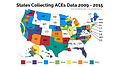 ACEs Study State Data 2009-2013


-
Adverse childhood experiences
-
Adverse childhood experiences
-
Adverse childhood experiences
